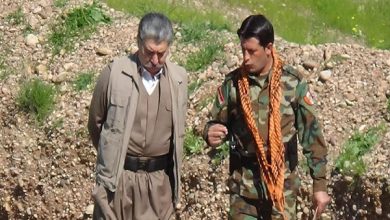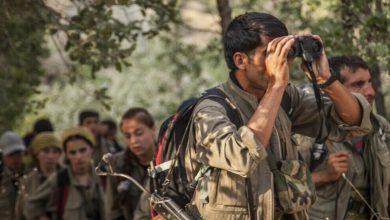


Rozita’s story is a clear example of the tragic phenomenon of “child soldiers”—teenagers who, instead of pursuing their education and future, fall prey to armed groups and are turned into tools for propaganda and military use.
The recruitment and exploitation of minors by non-governmental armed groups is a disturbing and often-hidden aspect of human rights violations in Iran’s western region.
Rozita Ahmadi, a teenage girl from Paveh (born in September 2007), is just one of the victims of this tragic scenario. At the age of 14 (in June 2022), along with her friend Rozha Shamseddini, whom she had discussed the decision to join with at school, Rozita fled her home. Influenced by a tumultuous family environment and the deliberate deceptions of individuals affiliated with the armed group known as the Democratic Party of Iranian Kurdistan, she was lured into the group. Rozita’s story is just one example of a dangerous trend in which teenagers, especially girls, are turned into propaganda and military tools for political groups instead of leading healthy lives and pursuing their education. This is a clear case of “child soldiery” and a blatant violation of the principles of child rights.
In this account, Rozita Ahmadi speaks about her birth, the tense atmosphere at home, her passion for music, and finally, the process that led to her being deceived and recruited by individuals associated with the Democratic Party of Iranian Kurdistan. It’s a bitter narrative that should serve as a serious warning to relevant authorities and social activists about the new methods of recruitment, especially in the context of cyberspace.
Rozita is currently a student in her senior year of high school, and she also practices sports and plays the kamancheh. After 18 months of membership, she finally returned to Iran on December 16, 2023, following her family’s persistent efforts.
Birth; Tensions at Home, Loneliness, and Anxiety
Rozita: I was born on September 22, 2007, in the city of Paveh. My family was of average financial means, but the atmosphere at home was not peaceful. My parents were always arguing, and these conflicts had a significant impact on me. I’ve been interested in music since I was a child and have loved the kamancheh in particular, which I have been learning for several years. I continued my education and am now a senior in high school. At first, I thought my life had a clear path, but then things suddenly changed.
The Deception on Instagram
Rozita: The loneliness and pressures at home led me to seek someone who could understand me. It was at this time that I came across an Instagram account that seemed very compassionate and intelligent. I later found out this person was affiliated with the Democratic Party of Iranian Kurdistan. They messaged me for a while, listened to my stories, and told me, “You have the right to choose for yourself.” They constantly spoke about freedom, traveling to Europe, and education. For a teenage girl tired of her home situation, these words were very tempting.
Fleeing with Rozha at 14
Rozita: No, we didn’t have a specific plan. My friend Rozha Shamseddini and I talked a lot. The same person who I was in contact with on Instagram gradually started talking to Rozha as well, and asked us to “come and be free from all the limitations.” They told us that age was not an issue and that everything would work out later. On June 4, 2022, when I was 14 years and 9 months old, I fled with Rozha and crossed the border illegally. I only took a backpack and a few pieces of clothing, and I had no idea what challenges I was about to face.
Question: Were your families aware of your communication with that person or your plan to flee?
Rozita: No, no one knew about it. I was afraid and thought if I spoke about it, they would stop me. Also, that person and the individuals who were supposed to take us kept saying, “Don’t worry, everything is fine, no one will notice.” The reality was that we hid it from our families because we wanted to escape the current situation as quickly as possible.
Question: When you arrived at the group’s headquarters, what was your first impression? Did it resemble what they had promised?
Rozita: Not at all. I had hoped for a free life and probably better conditions, but I was met with a completely different reality: a life of strict control, military training, hard physical labor, and many restrictions on contact with the outside world. There were no promises about Europe or education. We were constantly told, “You who grow up here will play an important role,” but there was no logical explanation for this.
The Armed Group’s Disregard for New Members’ Ages
Rozita: This point is very important and needs to be clarified: I was under 18 when I arrived there, even under 15. But the group members were fully aware of our ages. Nevertheless, they were indifferent to my and Rozha’s ages. One of the members explicitly told me, “You don’t look as young as you are; you’re mature and can work; no one will suspect a thing.” This shows their deliberate oversight. Instead of resisting the recruitment of a child, they took advantage of our young age. This is very painful for me.
Question: What was your training period and daily routine like there? Were you directly involved in missions?
Rozita: Yes, the days consisted of physical and military training. We woke up early in the morning and performed difficult exercises, including guard duty and moving heavy equipment. We were constantly being brainwashed with terms and promises of “steadfastness for freedom.” Some days, we were even assigned dangerous tasks that I was not at all prepared for. We were not allowed to contact our families, and the disregard for our age meant that the commanders placed no restrictions on using us.
Question: What were the conditions like in terms of hygiene, food, and personal safety?
Rozita: The conditions were very difficult. The food was insufficient and often repetitive, sanitary facilities were scarce, and the sleeping and resting conditions were inappropriate. In terms of safety, I was always worried about what would happen to me if I complained. People who had requested to leave were threatened, or there were rumors about their disappearance. This environment created a constant feeling of insecurity and fear in me.
Question: Did you encounter other teenagers or people who were underage like you?
Rozita: Yes, I saw a few other people who were clearly teenagers. Some of them had come from different parts of Iran. We talked and realized that many of them had also been deceived with promises of migration or work. This shared experience shows that the recruitment of children and teenagers was a pattern, not a random incident.
Question: How did your family find out, and what actions did they take?
Rozita: After a while when we didn’t return, my family realized I was missing and started looking for me. At first, they thought I had gotten married or was hiding with friends, but when there was no news, their search became more serious. My parents and relatives tried to contact the group through intermediaries. My father went there several times with an intermediary but returned with no results. Finally, after their continuous efforts, with the help of some acquaintances, arrangements were made for me to leave the group.
Question: How did your departure happen? Did you manage to escape on your own, or did your family help you?
Rozita: My departure was a combination of my own efforts and my family’s persistence. Initially, my family tried to get permission for my return through their acquaintances. Their representatives went there and came back several times. Finally, after about 18 months, on December 16, 2023, with my family’s continuous efforts and the help of an acquaintance, I was able to be transferred to Sulaymaniyah, where I stayed with my family until I could return to Iran. To be honest, I was very scared, but I was happy to be back.
Question: What challenges did you face on your way back? What were the psychological and social challenges?
Rozita: The challenges were immense. First, I had experienced a lot of bitterness and psychological pressure. Fear, a sense of betrayal, shame for having fled my family, and constant anxiety. When I returned, society and even some acquaintances looked at me with accusatory glances. My education was disrupted, and it took me a while to get back to class. Psychologically, there are still moments when I have nightmares or get scared by loud noises. But over time, I’ve tried to rebuild a normal life.
Question: How are you living now? What about your education, work, or hobbies?
Rozita: I am now back in Paveh and trying to continue my studies. I am currently studying for both my junior and senior years of high school at the same time. Music has been a sanctuary for me; I’ve continued playing the kamancheh, and it has been a great help in bringing me peace. I’m trying to become independent through education and small jobs.
Question: Are you in contact with Rozha? What’s her situation?
Rozita: Unfortunately, my contact with Rozha has been cut off. She went there at the same time as me, and her path was a bit different. I heard through intermediaries that she eventually returned home too, but I don’t have any more details about her situation. I’m worried about her and hope she is doing well.
Question: Were you subjected to violence there?
Rozita: This question is very sensitive for me, and it is painful to express. Fortunately, I don’t have to disclose the details, but I did experience psychological pressure and threatening situations whose effects still remain with me. The most important point is that we, as teenagers, were exploited and turned into tools for the groups’ goals.
Question: What do you regret or feel most sorrowful about?
Rozita: My biggest regret is that I was naive enough to believe them, and because of my young age, these groups took advantage of my vulnerability. I wish someone had warned me sooner or that my family had known how to deal with my psychological issues so I wouldn’t have gone looking for dangerous solutions.
Question: If you wanted to send a message to teenagers and families, what would you say?
Rozita: To teenagers, I would say: “Don’t trust tempting and strange promises on social media; your life and future are valuable. If you have conflicts in your family, seek help—talk to teachers, counselors, or trusted people. No easy promise is worth losing your safety and education.” I would also advise families: “Listen to your children and create an environment for dialogue so that teenagers don’t seek dangerous solutions.”
Question: Have any legal actions or official reports been filed against the group or the individuals who deceived you?
Rozita: My family made some efforts in this regard, but legal and official pursuits are very difficult, especially when many of these processes happen across the border and under the cover of armed groups. We focused most of our time on bringing me back and improving my situation, but I hope that in the future, legal action can be taken to prevent the recruitment of children.
Question: What is most important to you today?
Rozita: Creating an independent and secure life is very important to me. I want to continue my education, pursue my kamancheh, and find a job so I’m not dependent on anyone anymore. I also hope to be able to share my experiences with others so that maybe fewer people will be deceived.
Question: If there’s one final point you want the reader to know, what is it?
Rozita: The point to be aware of is that the recruitment of children and teenagers with false promises is a bitter reality. The groups often take advantage of the deliberate disregard for their age and use teenagers like me as labor or soldiers. Please be vigilant and pay attention to the warnings. The digital world can be both helpful and threatening.