
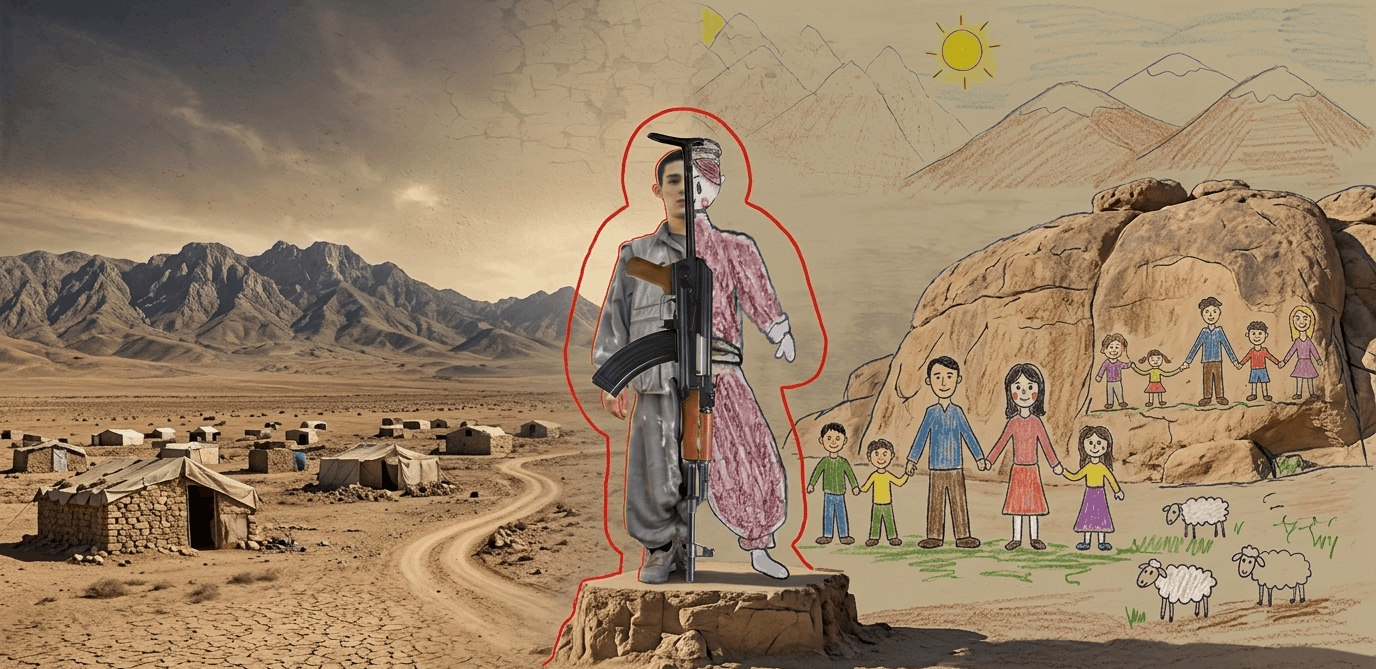
Rivar Abdanan, the spokesperson for the Free Life Party of Kurdistan (PJAK), spoke about concepts such as “democracy,” “the rights of nationalities,” and the slogan “Woman, Life, Freedom” in a recently published video interview. However, parts of his statements regarding the presence of individuals under the age of 18 within the structures affiliated with this group raise serious, well-documented questions in the field of child rights and the international obligations of non-state armed groups. These are questions that, given the published reports and documents regarding child soldiering and enforced disappearance within structures affiliated with PJAK and the PKK, cannot be ignored.
When questioned about child recruitment, Abdanan emphasizes that according to the group’s statute, the age of membership is set at 18. Yet, he simultaneously explains that minors under this age are also transferred to the group’s headquarters and kept in “educational centers.” This very explanation reveals one of the primary contradictions in PJAK’s official narrative. According to international standards, including the commitments declared by these groups within the framework of the Geneva Call, any direct or indirect connection of children with armed structures—even in educational, service, or support roles—can be considered a violation of child rights. Therefore, distinguishing between “official membership” and “presence in affiliated centers” does not necessarily absolve the group of its legal liability.
The significance of this contradiction increases when considering the documents published by the Iranian Kurdistan Human Rights Watch (IKHRW) and the book The Lost—a book that compiles a collection of documented cases concerning individuals whose fates remain unknown after joining Kurdish paramilitary groups. This book records the specifications, photographs, and information of dozens of adolescents and youths whose families have had no contact with their children for years. In many cases, no clear information regarding their vital status, location of detention, or ultimate fate has been provided. These documentations have turned the issue of enforced disappearance within the structures affiliated with these groups into one of the most critical human rights concerns in this file.
This matter becomes even more severe when the list of casualties announced by PJAK-affiliated media is cross-referenced with the data published in the book The Lost and other human rights reports. Cases such as Asrin Mohammadi, Naser Alizadeh, and Benyamin Farajzadeh—who, according to published information, were recruited at a young age and whose deaths in armed conflicts were later announced—raise significant questions about the claim of mere maintenance in “educational centers.” The publication of official images and notices of these individuals as deceased forces or organization members is inconsistent with the narrative of a non-military, supportive presence of children. This raises the critical question of how these minors were transferred from an allegedly educational environment into the arena of armed conflicts.
Under such circumstances, transparency serves as a vital criterion for evaluating the validity of these claims. If the PJAK spokesperson believes that the children present in these structures are merely under protection and care and play no role in military activities, it is only logical that independent journalists, multinational human rights reporters, and neutral international organizations be allowed to visit these headquarters. Free access to the camps, dialogues with members, and the possibility of conducting independent interviews with the minors present in these centers could clarify a major part of the existing ambiguities. In the absence of such independent monitoring, the gap between the official narrative and the documentation published by human rights organizations will persist.
Another part of Abdanan’s statements is dedicated to the claim that children and adolescents take refuge in this group due to family problems or social pressures. However, field reports published by families and human rights organizations present a different narrative. In several cases, families have stated that their children disappeared without their knowledge or consent, only to be found later in camps affiliated with PJAK or the PKK. Furthermore, some reports allege that minors are recruited through promises such as continuing their education, employment, or being transferred to Europe. The repetition of these patterns indicates that the issue is not merely limited to “voluntary refuge” and requires an independent and transparent investigation.
The core contradiction lies in the fact that while PJAK attempts to present itself as a defender of freedom, political participation, and human rights, it offers an explanation for the presence of children within its affiliated structures that does not align with the recognized principles of child rights and international commitments. In international law, the right of the child to remain disengaged from armed conflicts is a fundamental and non-derogable right. No political, security, or ideological justification can legitimize the presence of a child in military and paramilitary environments, even if this presence is described under the guise of “protection” or “education.”
Accordingly, the issue of child soldiering and enforced disappearance within the structures affiliated with PJAK is not merely a political or media dispute; it is a human rights issue that demands transparent accountability, family access to their children, monitoring by independent bodies, and practical adherence to international obligations. Any democratic claim can only be considered valid when it is practically consistent with the fundamental principles of human rights, particularly the rights of children and the right of families to be informed of the fate of their children.