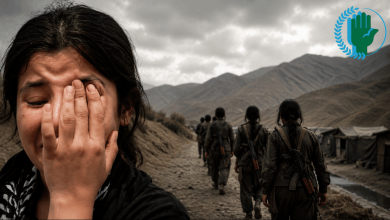

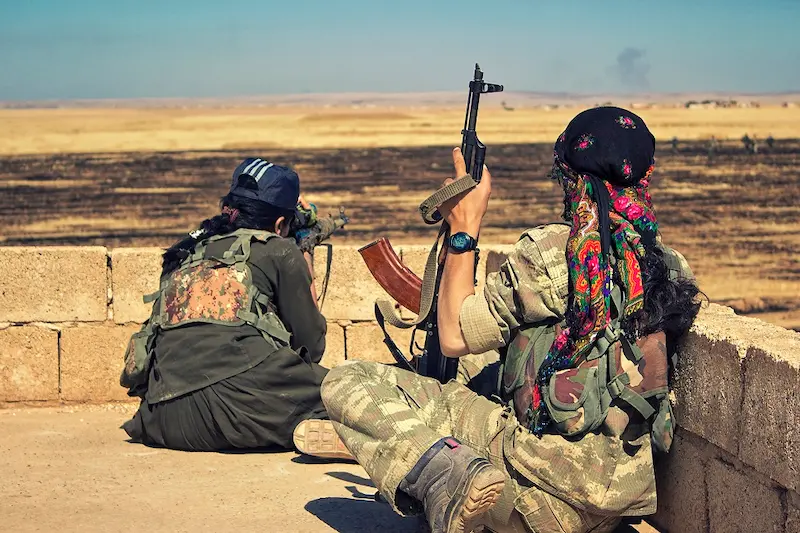
The interviewee’s name in this report has been given as “Hira” to protect her life and safety. The name of the city where she lives has also been changed; “Marivan” is used as a pseudonym for her place of residence.
This report is based on an audio and video interview with “Hira,” conducted at her home in one of the neighborhoods of the city where she lives. In the interview, Hira provides a detailed account of how she became acquainted and communicated with members of the Kurdistan Freedom Party (PAK), her departure from Iran at the age of fifteen, her transfer to the group’s bases in the Kurdistan Region of Iraq, life within the organization’s military structure, threats, torture, solitary confinement, repeated attempts to escape, witnessing the deaths and suicides of several members, and, ultimately, her own escape.
Previous parts (One – Two – Three)
Previous summary: At the age of fifteen, Hira became acquainted with the Kurdistan Freedom Party (PAK) through Instagram. This contact led to threats against her family’s lives and ultimately forced her to flee her home and illegally enter the group’s base in Koya. There, she encountered gender discrimination, torture, and pressure to marry “Ribaz Sharifi,” one of the group’s senior commanders. During a controlled meeting with her family in Erbil, she asked to return home, but instead of being released, she was interrogated and punished. In Part Three, after her friend “Soma” exposed a collective escape plan, Hira was subjected to another wave of torture: forced guard duty in the winter cold, the discovery of the wire cutters she had hidden, and a severe beating that seriously injured her spine, after which she was denied surgery. She was held in solitary confinement for one month and was forced to make a video confession under pressure. She then witnessed her friend “Shilan” being captured while attempting to escape and killed by Ribaz Sharifi, and shortly afterward witnessed another girl, “Hawar,” die by suicide.
After some time, Hira’s family once again arrived unexpectedly to visit her. According to Hira, the group permitted the visit in order to prevent public concern and reaction among people in Iranian Kurdistan.
She says that multiple cameras and guards were present in the visiting room. To protect her family’s lives, Hira says she falsely told them in front of the cameras that she was happy to remain there and that she liked the place.
Her mother was distraught and crying. Hira says she slept beside her father that night. At around four in the morning, she woke up and realized that the guards were asleep and that the camera was no longer recording. She quietly woke her father and said: “Father, I can’t stay here anymore and I want to escape, but don’t tell my mother anything and don’t say anything to anyone.”
The following morning, when Ribaz Sharifi arrived, Hira’s father told him: “Why won’t you let my daughter return? She begged me last night to let her come home!”
According to Hira, Ribaz told her father, apparently to calm him and put him off: “Okay, I’ll arrange her release and send her back.” But Hira says that as soon as her father left, she was transferred to a very small solitary cell.
According to her, the cell measured approximately one and a half meters by one and a half meters. It had no electricity and was in complete darkness. She says her hands were also restrained. Hira decided to go on a hunger and water strike. She says she consumed neither water nor bread for a week, to the point that she was struggling to breathe.
According to Hira, the death of each Peshmerga meant the loss of the monthly allowance that, she says, the group received from the Barzani government. For this reason, when she lost consciousness, she was taken to a hospital and revived. Even on the hospital bed, she says, an armed guard was stationed beside her.
After returning to the cell, Hira says that approximately one month later she was allowed to take a shower. She says that at the PAK base, the girls’ hair was shaved completely. Hira recalls Atousa and says that Atousa, who had been there for five years, had very short hair. According to Hira,
Atousa had told her that the girls’ hair was shaved so that if one of them escaped, her altered appearance and shaved head would cause her to be regarded as an unusual or disreputable person in Iraqi society, increasing the likelihood that she would be identified and detained. Hira’s own long hair, which she says reached below her waist, was also completely shaved.
In the bathroom, she noticed a razor-like needle hidden in a crack in the wall. She picked it up, concealed it among the remaining hair on her head, and took it back to her cell. Hira says she practiced with the needle for days until she was able to unlock her handcuffs. After practicing, she hid the needle in a crack in the corner of the wall.
She had also memorized the guards’ movements and routines. According to her, the guards came to the cell once a day, between nine and ten at night, to bring bread and water, and did not check on her again until morning. On Thursday night, after the guards’ nightly check, Hira unlocked her handcuffs. She then used the metal from the handcuffs to break the tinted glass of the small window above the cell. Her hand was cut by the shards of glass.
Without shoes, Hira lowered herself through the window, which was approximately two meters above the ground, and jumped down. The fall again inflicted severe trauma on the already injured vertebrae in her back. According to her, the area belonged to the homes of married members and pomegranate orchards.
Hira says she moved slowly and cautiously through the pomegranate trees and down the steep terrain until she reached the perimeter fences. She says the fence posts were buried approximately one meter underground in a crossed formation, making it impossible to dig beneath them.
According to her, she climbed the two-meter fence and threw herself over the coils of barbed wire to the other side. The barbed wire, she says, cut and tore her hands, veins, and various parts of her body, causing significant blood loss. On the other side of the fence were tall wheat fields. Hira says the escape took place in late spring, during the harvest season.
She threw herself into the wheat. One of the guard dogs detected her because of the smell of blood and began barking. The camp’s floodlights came on and the guards began searching.
But according to Hira, they searched mostly inside the fenced area because they did not believe anyone could have crossed the barbed wire. She crawled through the wheat and pressed herself against the stone face of a nearby mountain.
The guards, she says, assumed that the dogs had seen a cat and returned to their posts after approximately half an hour. As soon as they left, Hira began running barefoot and wounded. She says shards of glass, sharp stones, and thorns were cutting into her feet, but because of the anxiety she was experiencing at the time, she did not feel much pain.
According to her, she was unable to walk for approximately one week after the escape. Hira says she was wearing an orange reflective sweatshirt and blue tracksuit pants, both of which had been torn to shreds while she crossed the barbed wire. From nine at night until around six in the morning, she continued moving and running without stopping along the rugged route between Koya and Erbil. Near sunrise, she reached several houses in a relatively level area.
According to her, all the houses were empty except one, whose residents were also planning to move and leave the area that day. Hira says the woman who owned the house had woken early that morning and was shocked and frightened when she saw Hira’s bloody and disheveled condition. She pleaded with the woman: “Don’t be afraid, just give me a glass of water!”
The homeowner had five daughters and one son. Hira says that when the woman saw her face, she began crying and said: “My daughter died three weeks ago, and your eyes are exactly like hers. Don’t worry, I’ll help you.”
At around noon, according to Hira, forces affiliated with Hussein Yazdanpanah had traced her to the vicinity of the village. From behind a window, she could see members of the group searching for her in the mountains. In one corner of the house stood a commercial upright refrigerator.
The family emptied everything from inside the refrigerator but did not unplug it, so that the refrigerator being switched off would not arouse suspicion. They hid Hira inside the refrigerator under a blanket. Hira says Hussein Yazdanpanah personally entered the house.
According to her, Yazdanpanah had previously purchased milk from the family and was therefore familiar with them. Hira says that, while searching for her, he presented a story and said: “A crazy girl has escaped from our base. Her fiancé was killed in an Iranian airstrike, and she has severe diabetes and will die if she does not take insulin. I’m worried about her like she’s my own daughter!”
Hira says she remained hidden inside the refrigerator in extreme cold for approximately four hours. The cold became so severe that her hair froze and she felt that she was losing consciousness.
During the final hour, the family’s daughter unplugged the refrigerator because she was afraid Hira would freeze to death. After Hussein Yazdanpanah left, Hira emerged from the refrigerator; however, because of the sharp difference in temperature and her physical condition, she lost consciousness and remained unconscious for approximately two hours.
The family bandaged her hands and feet. Hira says that after eighteen months away from Iran, she had even forgotten Iran’s country code, 0098. She asked the family’s daughter to install Instagram.
She then searched for the names of people from her hometown on Instagram and sent them messages. She wrote: “Please, I beg you, call this number and tell my father to install Instagram!”
But according to her, at first no one trusted the messages. Eventually, she found the page of a cameraman from her hometown named “Zanyar.” Hira sent him a message and established a video call. During the call, she showed Zanyar her handcuffs, face, and bodily injuries and asked him to contact her father immediately.
According to Hira, Zanyar informed her family. Her sister also created an account and established a video call. Hira says that when her family heard her voice, the house filled with crying and wailing. According to her, the call took place at two in the afternoon.
Hira says her parents entered Iraq at ten that night, bringing food and supplies to thank the family that had helped her. They then took her to the Iranian Consulate in Sulaymaniyah.
According to Hira, consulate officials explained that her legal return to Iran required a guarantee of safe passage and legal authorization from Iran, a process that could take approximately one month. But she says remaining in Iraq meant risking being killed by PAK forces.
For this reason, she and her family went to the Residency Administration, or Asayish, in Erbil to have her deported. But, according to her, they were also told there that her departure and deportation required the group’s approval. Hira says her family insisted and pressed the authorities strongly. After seeing her severe injuries and witnessing the family’s persistence, Asayish forces eventually provided them with a vehicle and transported them to the Bashmaq border crossing.
Hira says that when she saw Iranian soldiers at the Bashmaq border, she experienced a strange feeling. She says that for eighteen months she had been told that Iranian forces were the enemy, yet she now saw those same forces as her means of escape and safety.
However, according to her, border officials said that she could not enter Iran without legal authorization. Hira and her family remained for three days in the border’s no-man’s-land between Iran and Iraq, in uncertainty and fear of a possible assassination attempt.
She says her mother pleaded with the officials through tears: “Arrest my daughter as a suspect; just don’t let her remain here!” Eventually, the Iranian authorities took custody of her. Hira says she was initially interrogated for approximately eight hours at the border and then for several more hours in Marivan. She was supposed to be transferred to a detention facility.
But after the case was referred to the prosecutor’s office, the prosecutor examined her identity document and stated: “Under the law, the detention and interrogation of persons under eighteen is prohibited.” According to Hira, as a result of this decision, the detention and interrogation process was halted and she returned home with her family.
After her return, she says, only several administrative questioning sessions were conducted, and the case was ultimately closed. But returning home did not mark the end of Hira’s difficulties.
She says that after returning, her father’s home had become an unfamiliar and painful environment. Hira says she felt like an unwanted person in her father’s house and no longer recognized the other members of her family as she had before. The taunts and reproaches of those around her, she says, placed her under severe psychological pressure.
She says some people told her: “You were gone for two years, and no one knows what you did.” Hira says these remarks shattered her emotionally. At the end of her account, she says that she repeatedly considered suicide and came close to taking her own life.
But according to her, each time she ultimately abandoned the idea and returned to life because of her deep affection for and strong attachment to her younger brother.
The audio and video recording of this interview is held in the archives of the Iranian Kurdistan Human Rights Watch. In accordance with principles of confidentiality and the protection of the interviewee’s identity and safety, it may be made available to researchers, lawyers, documentary filmmakers, academics, and human rights activists upon a formal request to the Iranian Kurdistan Human Rights Watch.