
By Dr. Ali Farahmand
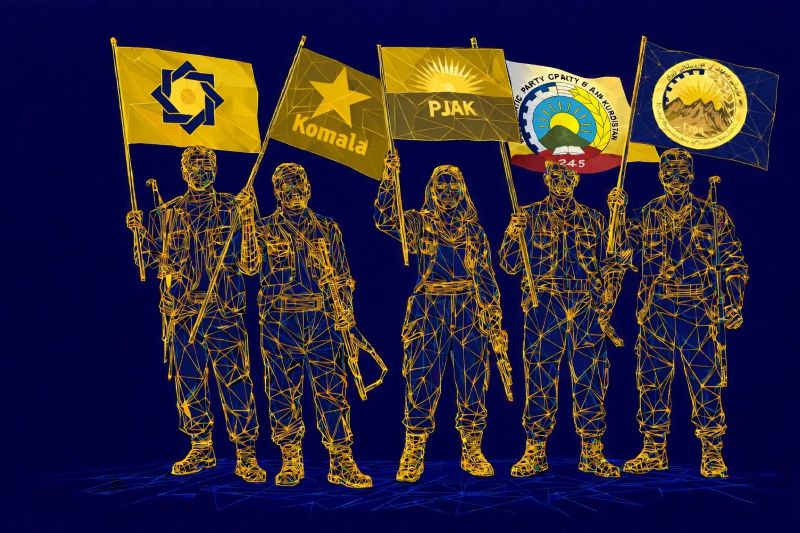
In December 2012, inside a Geneva conference hall, representatives of the Democratic Party of Iranian Kurdistan (PDKI) signed a legal instrument prohibiting the recruitment and use of child soldiers. Three years later, the Kurdistan Freedom Party (PAK) executed the same document. Neither group was a party to the Geneva Conventions, nor had any sovereign state compelled their commitment. Nevertheless, a binding legal document was executed.
This scenario raises a fundamental legal question: how can a non-state armed group (NSAG) that is not formally party to any international treaty be bound by international humanitarian law (IHL)?
This is precisely the core inquiry that Jan K. Kleffner, Professor of International Law at the Swedish Defence University, has placed at the center of his academic research for over a decade.
Kleffner, who served as Head of the Centre for International and Operational Law at the university from 2010 to 2020 and has acted as a consultant for the International Committee of the Red Cross (ICRC), the International Criminal Court (ICC), and the International Criminal Tribunal for the former Yugoslavia (ICTY), built a cohesive chain of legal reasoning across four distinct publications. This body of work provides a clear analytical framework for cases involving groups such as PAK and PDKI.
The starting point, according to Kleffner, is establishing when a conflict reaches a sufficient degree of organization and intensity to fall under the legal classification of a non-international armed conflict (NIAC). In a 2019 study published in International Law Studies titled “Legal Fog is an Illusion,” he scrutinizes these cumulative thresholds—a foundational legal inquiry that must precede any discussion regarding the humanitarian obligations of Kurdish armed factions.
The subsequent step addresses why a non-state actor, once the NIAC threshold is met, becomes bound by rules it never formally signed. Kleffner resolves this in a 2011 article in the International Review of the Red Cross titled “The Applicability of International Humanitarian Law to Organized Armed Groups.” Furthermore, in a chapter published in System Criminality in International Law (Cambridge University Press, 2009), he addresses how both individuals and the collective group itself can be held accountable for systematic patterns of violations.
The pivotal link connecting this framework to PAK and PDKI lies in his recent research. In “The Unilateralisation of International Humanitarian Law” (International Review of the Red Cross, 2022), Kleffner argues that elements of contemporary humanitarian law no longer rely strictly on state-centric reciprocity between belligerents. Instead, they manifest as unilateral commitments whose legal validity exists independently of an opponent’s conduct. In this study, he explicitly cites Geneva Call‘s Deeds of Commitment as an empirical example of this shift.
In essence, the theoretical framework that brought PDKI and PAK to Geneva in 2012 and 2015 directly reflects the scholarly concepts Kleffner conceptualized over subsequent years.
Ultimately, Kleffner’s research demonstrates that binding non-state armed groups to humanitarian norms is not merely a political or moral issue, but a structured process governed by international law. Instruments such as Geneva Call’s Deeds of Commitment represent a broader trajectory translating humanitarian norms into operational restraints—strengthening civilian protections even when armed actors operate outside formal treaty systems. However, assuming such pledges is merely the beginning; evaluating real compliance requires empirical scrutiny of documented field behavior, command hierarchies, internal disciplinary procedures, and independent verification of human rights adherence.