
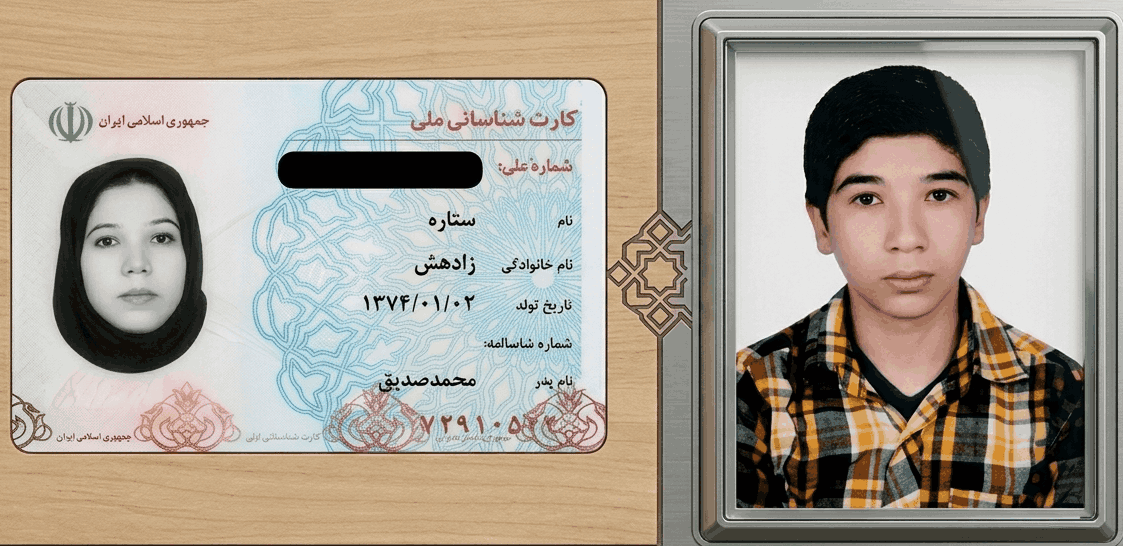
Along the tense borders of Iran and Iraq, stories unfold that rarely find their way into official reports. These are the narratives of women who, in a desperate bid to escape poverty, forced marriage, or societal oppression, head to the mountains in search of freedom. Ultimately, however, they find themselves ensnared in structures where leaving is far more difficult than entering.
The account of “Setareh Zadehsh” and her brother is not merely a personal experience; it is a window into the mechanisms of recruitment, control, and human detention employed by certain non-state armed groups stationed in the border regions of the Kurdistan Region of Iraq.
In the foothills of the Zagros Mountains, where politics, warfare, and ethnic identity have been intertwined for years, non-state armed groups do not feed solely on geopolitical fractures; they also draw strength from social divides. Poverty, forced marriage, educational deprivation, familial collapse, and depression have become informal pathways for recruitment—a trajectory that is clearly visible in Setareh’s case.
Setareh was forced into marriage at the age of 16, an experience that social activists in the border regions note remains a bitter reality for a segment of women and girls in traditional communities. Deprived of education and personal independence, she encountered narratives that painted life in the mountains as a form of “liberation” and “the reconstruction of individual identity.” This is precisely the vulnerability that many radical and armed groups exploit: converting psychological and social distress into ideological dependency.
However, what transpired after arriving at the border headquarters stood in stark contrast to the initial imagery. According to individuals who have experienced these structures firsthand, free departure, independent communication with family, and even the right to question the group’s ideology face severe practical restrictions. Many defectors speak of rigid disciplinary regimes, continuous ideological indoctrination, and psychological pressure designed to sever emotional ties with the outside world.
Amid this, the fate of Setareh’s brother introduces a more complex dimension to the case. Driven not by political ideology but by the desire to find and return his sister, he embarked on this path, only to find himself trapped within the exact same system. This pattern has been previously documented in reports concerning certain Kurdish armed groups: leveraging familial and emotional ties to solidify dependency and prevent the defection of members.
From the perspective of international humanitarian law, this situation is not merely a political or security issue. The core concern revolves around the right to personal liberty, the right to leave, the right to maintain contact with family, and immunity from psychological and military exploitation. When an individual is held without the means for open communication, without independent access to family, and without the viable option to exit an armed structure, the issue transcends “political membership” and enters the domain of fundamental human rights.
Several international reports over the past years have raised concerns regarding the recruitment of minors and the restriction of members’ freedom to leave non-state armed groups in the region. Documentation published by Human Rights Watch and various United Nations bodies have repeatedly highlighted the danger of exploiting vulnerable individuals in non-state conflicts. Furthermore, Geneva Call has documented the commitments of certain Kurdish groups to ban the use of child soldiers—an issue that underscores deep-seated concerns regarding the induction of underage individuals into the region’s armed structures.
Under such circumstances, the accountability of sovereign states cannot be overlooked. Based on established principles of international law, the Government of Iraq is responsible for exercising sovereignty and preventing unlawful armed activities within its territory. Concurrently, the Kurdistan Regional Government (KRG) bears political and legal responsibility for human security in areas effectively under its administrative or security oversight. The ongoing operations of isolated military camps and closed structures in border zones raise serious questions regarding accountability, monitoring, and the enforcement of the rule of law.
At the international level, reactions have routinely been cautious and restrained. Part of this hesitation stems from the intricate political dynamics of the region and the role that certain Kurdish factions play in Middle Eastern security equations. However, from a human rights standpoint, no geopolitical consideration should justify the neglect of fundamental human rights, particularly when women, minors, and vulnerable populations are involved.
Setareh’s case is more than just the story of a woman who returned from the mountains. It exposes a wider cycle: one where social vulnerabilities are converted into raw material for extremist structures, and human beings disappear along the border separating “membership” from “captivity.”
Setareh’s return to civilian life does not conclude this story, as her brother and many others remain in a state of indefinite limbo. The fundamental objective for human rights organizations and international lawyers is not merely to take political stances against groups, but to defend principles that must never fall victim to expediency: the right to leave, the right to maintain family contact, the prohibition of exploiting vulnerable persons, and the ban on the forced or deceptive deployment of human beings in military structures.
If the international community remains silent in the face of such cases, the primary question will not be what happened to “Setareh,” but rather how many other “Stars” must disappear before this cycle is recognized as a severe human rights crisis?
Sources and References
-
Human Rights Watch — Reports and documentation regarding human rights and the status of non-state armed groups in the Middle East.
-
Amnesty International — Documents and reports related to human rights violations, unlawful detentions, and individual rights in armed conflicts.
-
United Nations — Documents concerning international humanitarian law, protection of civilians, and the prevention of the use of child soldiers.
-
Geneva Call — Documents related to the commitments of non-state armed groups regarding the prohibition of using children in hostilities.
-
International Covenant on Civil and Political Rights (ICCPR).
-
Convention on the Rights of the Child and its Optional Protocol on the involvement of children in armed conflict.
-
Fundamental principles of international humanitarian law concerning individual liberty, the prohibition of forced labor, and the right to family communication.