

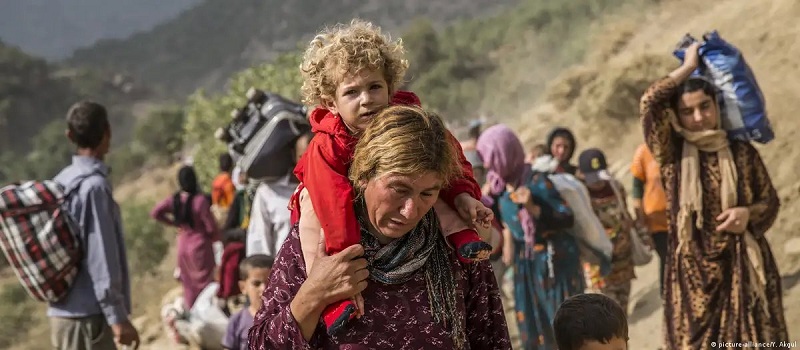
An academic paper by Hawre Ahmed Mohammed moves beyond a tragic narrative to analyze the ISIS attack on the Yazidi community through the lens of international criminal law. The study demonstrates how mass killings, severe physical and mental harm, deliberate destruction of living conditions, forced transfer of children, and sexual slavery constitute core elements of genocide.
Titled “The Last Genocide Against the Yazidi People“ the article is authored by Hawre Ahmed Mohammed—Executive Director of the Kurdistan Center for International Law (KCIL) and a human rights legal scholar. Published online by Cambridge University Press on May 16, 2023, in the journal Review of Middle East Studies (Vol. 56, No. 1, pp. 108–122), the paper forms part of a special issue titled “Rethinking the Anfal Legacy and Reimagining Genocide in the Contemporary Middle East.”
The study evaluates ISIS atrocities against the Yazidi population against the legal criteria established by international jurisprudence.
Mohammed begins by examining the rise of ISIS as a non-state armed group that seized vast territories across Iraq and Syria, establishing pseudo-state military, ideological, and administrative structures. However, the core legal question extends beyond the sheer scale of violence: it investigates precisely when widespread atrocities transition from isolated war crimes into a systematic policy of extermination targeting a specific group.
The author bases his argument on the status of Yazidis as a protected religious group under the Genocide Convention. He analyzes a documented pattern of behavior comprising intentional killing, infliction of severe bodily and psychological harm, calculated destruction of community life, and the abduction and forced transfer of Yazidi children.
The significance of the study lies in its departure from mere moral condemnation. Instead, it systematically applies the conduct of a non-state actor to the statutory elements defined in the Convention on the Prevention and Punishment of the Crime of Genocide.
Under international law, establishing genocide does not depend solely on the casualty count; the decisive factor is the special intent (dolus specialis) to destroy, in whole or in part, a national, ethnical, racial, or religious group.
From this legal perspective, the ISIS assault on the Yazidis was not a series of random acts of war, but a coordinated policy aimed at the destruction of a targeted community.
Gender-based crimes occupy a central position in this legal analysis. The paper highlights systematic sexual slavery and violence against Yazidi women and girls, demonstrating that gendered atrocities are integral to the structural design of genocidal violence.
In legal terms, violence targeting women and children during conflict is not an inevitable byproduct of war; rather, it functions as a deliberate instrument to destroy community cohesion, enforce power, and advance broader criminal objectives.
Furthermore, the article addresses the critical issue of accountability. Beyond documenting atrocities, it confronts the legal mechanisms required to hold perpetrators responsible under national and international legal frameworks.
In this context, the ISIS case presents a critical precedent for international law: a non-state armed group, without possessing statehood, exercised territorial control, maintained a command structure, and committed top-tier international crimes. Consequently, the Yazidi case serves as an essential framework for establishing individual and command criminal responsibility within non-state armed structures.
Framing this study alongside the historic Anfal campaign provides crucial context. The issue’s editors note that Mohammed’s analysis of the 2014 attacks—including mass murder, severe harm, birth prevention, and child trafficking—illustrates why these combined acts satisfy the legal threshold of genocide.
Yet, the primary relevance of the paper today lies in demonstrating that impunity and institutional weakness are not legacy issues of the past; failing to ensure accountability directly enables the recurrence of organized violence.
For the Iranian Kurdistan Human Rights Watch (IKHRW), this analysis provides three crucial takeaways:
-
First, it evaluates a non-state armed actor strictly through established standards of international criminal law rather than political rhetoric.
-
Second, it demonstrates that documenting murders, child abductions, and sexual violence achieves legal weight only when individual events are linked to organizational structures and legal crime elements.
-
Third, the Yazidi experience directly informs IKHRW’s focus areas regarding child soldiers, enforced disappearances, gender-based violence, organized crime by armed groups, and the right to truth and justice.
This legal framework does not imply a direct equivalence between ISIS and other armed factions; every case requires independent examination based on its organizational structure, command hierarchy, and specific evidence. Nevertheless, the central lesson remains clear: non-state armed actors must not evade legal scrutiny or accountability simply due to their non-state status.
This principle renders “The Last Genocide Against the Yazidi People” a vital reference point for human rights advocacy, proving that confronting impunity requires converting human suffering into rigorous, testable, and actionable legal cases.