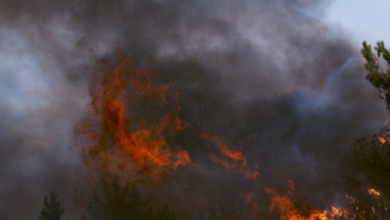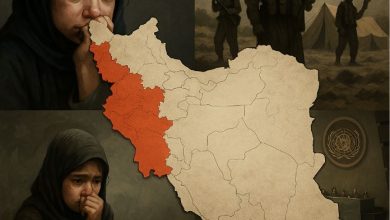

Report by the IKHRW Correspondent: Within the framework of the ongoing armed conflicts, the attacks by the United States and Israel on the territory of the Islamic Republic of Iran since February 28, 2026, represent a clear example of the systematic violation of the fundamental principles of International Humanitarian Law (IHL). These attacks, which initially began with claims of targeting military facilities, rapidly expanded to include civilian targets, private residences of ordinary citizens, and the country’s vital and economic infrastructure.
Such actions not only violate the principle of Distinction between military and civilian targets but also disregard the principles of Proportionality and Precaution in attack, leading in numerous instances to war crimes.
Violation of the Principle of Distinction and Attacks on Residential Areas
One of the most prominent violations is the direct or indirect targeting of densely populated residential areas. Reports indicate that during operations aimed at assassinating Iranian officials, multi-story residential buildings were selected as the sites of operation. These attacks have resulted in the deaths of hundreds of civilians, including women and children.
According to Article 48 of the First Additional Protocol to the Geneva Conventions (1977), parties to a conflict must at all times distinguish between the civilian population and combatants, as well as between civilian objects and military objectives. Attacking residential homes that lack military character is a blatant violation of Article 51 of the same protocol, which prohibits any attack that may be expected to cause incidental loss of civilian life which would be excessive in relation to the concrete and direct military advantage anticipated.
Furthermore, the pattern of damage to houses adjacent to military facilities in cities such as Tehran, Karaj, Isfahan, and Shiraz violates the Principle of Precaution (Article 57 of Protocol I). The attack on the “Girls’ Elementary School in Minab,” which resulted in the deaths of over 170 civilians—mostly children—is a prominent example of the failure to observe these principles. Such an act can be prosecuted as a war crime under Article 8 of the Rome Statute of the International Criminal Court (ICC).
Targeting Infrastructure Essential to the Survival of the Population
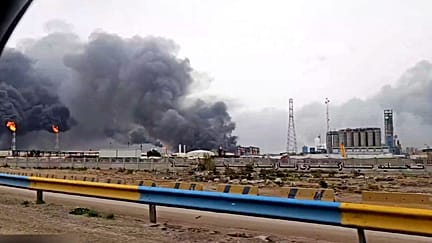
Another dimension of these attacks is the focus on the country’s economic and vital infrastructure. Major transport links (such as the B1 Bridge on the Tehran-Karaj highway), steel factories (such as Mobarakeh Steel and Khuzestan Steel), energy production centers, water and sewage facilities, and even healthcare centers have been targeted.
These actions directly violate Article 52 of Protocol I, which states that civilian objects shall not be the object of attack unless they make an effective contribution to military action. Infrastructure such as bridges, steel plants, and the power grid, which are essential for meeting the basic needs of the civilian population, are under special protection via Article 54 of Protocol I. This article prohibits any attack on “objects indispensable to the survival of the civilian population,” such as foodstuffs, drinking water installations, and electricity networks, and categorizes the use of starvation or deprivation as a method of warfare as a war crime.
Humanitarian Consequences and International Responsibility
The destruction of over 90,000 residential units, 760 schools, and 300 health centers, according to Iranian Red Crescent statistics, indicates a systematic pattern that can be interpreted as Collective Punishment (prohibited under Article 33 of the Fourth Geneva Convention). Beyond violating humanitarian law, these actions have intensified the humanitarian crisis in Iran and displaced millions.
From the perspective of international law, these attacks lacked a legitimate basis from the outset. Article 2(4) of the UN Charter prohibits the use of force against the territorial integrity or political independence of any state. In the absence of Security Council authorization or an imminent threat justifying self-defense (Article 51), these operations are considered acts of aggression.
The aggressor states are obligated to provide reparations for material and moral damages (the principle of State Responsibility). Iran can invoke these principles to file a case at the International Court of Justice (ICJ) against the United States and Israel or submit evidence to the ICC for the prosecution of responsible individuals. The international community is also duty-bound to react based on erga omnes obligations. Protecting civilians and vital infrastructure is not an option, but a legal imperative.