
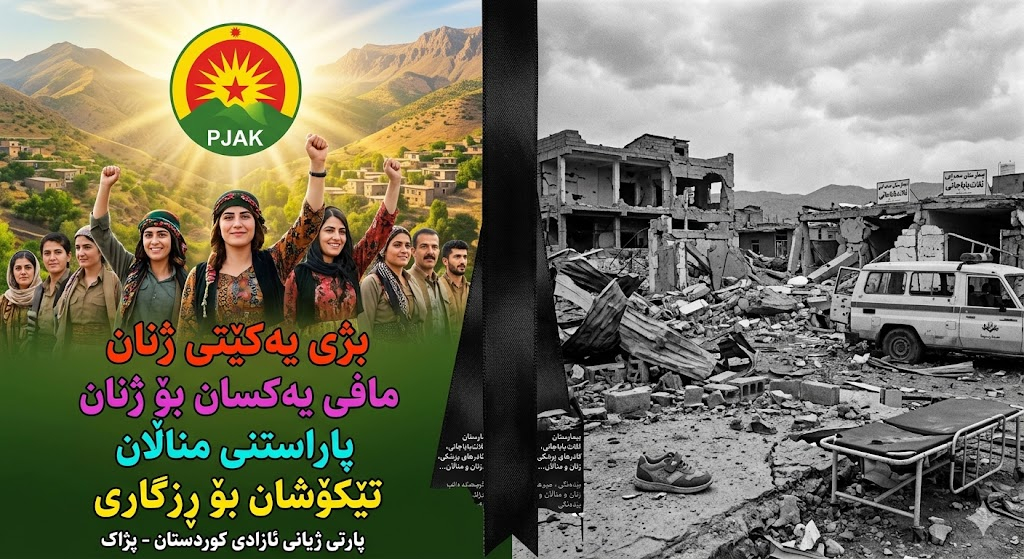
The war involving the United States and Israel against Iran has entered its fourth week. More than a thousand Iranian citizens have lost their lives in this conflict, national infrastructure has sustained serious damage, and several thousand others have been injured. This escalation marks the second major attack on Iran in 2026 (1404), with both occurring in the midst of nuclear negotiations. In this context, examining the approach of the militant group PJAK offers fascinating and important lessons. How has a group that considers itself a supporter of the people and claims to advocate for the rights of the Kurdish people reacted to these attacks and the assassination of Iranian citizens? For instance, what has PJAK done in response to the U.S. and Israeli attack on the field hospital in Thalath-Babajani? The initial and brief answer is: Absolute silence!
In an era where the Middle East faces its most complex security and political crises due to U.S. and Israeli attacks on Iran, the need for transparency, honesty, and genuine commitment to human principles is felt more than ever. In such circumstances, any movement or group that introduces itself as a defender of “the people” and “the rights of nations” is bound to remain committed to those same principles in practical tests. However, the recent behaviors and positions of the group known as the Kurdistan Free Life Party (PJAK) show a significant gap between the group’s claims and its actual performance. In its official literature, PJAK has always emphasized concepts such as “supporting the people,” “combating oppression,” and “defending civilians.” On the surface, these concepts are universal and defensible values.
But the credibility of such claims is measured not by their repetition in statements, but by how they confront real and sensitive events; where interests, costs, and difficult choices are at stake. The March 2026 attacks on Iran by the U.S. and Israel were one such decisive turning point. In these attacks, according to various international and documented reports, infrastructures were targeted that directly or indirectly affect the lives of ordinary people. Historical experience has also shown that any damage to infrastructure—from energy and communication networks to transportation routes—ultimately weighs most heavily on ordinary citizens. It is these people who face service outages, disruptions in daily life, and psychological insecurity. In such a situation, the natural expectation from a movement claiming to defend the people is to adopt a clear, explicit, and unambiguous position in condemning such attacks. However, what was observed from PJAK was not a transparent condemnation, but a kind of telling silence or, at best, indirect and marginal references.
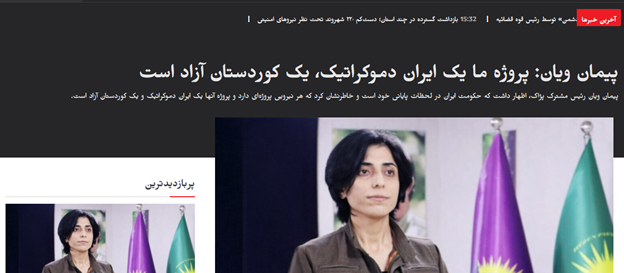
Repetitive, Ambiguous and Meaningless Words; No Explicit Condemnation of External Actors Against Iran
This silence is not only questionable but also worth reflecting upon from an ethical perspective. How is it possible, on the one hand, to emphasize the suffering of the people in numerous statements and present oneself by their side, but on the other hand, show no decisive reaction to actions that directly target a country’s infrastructure and consequently the lives of those same people? Is “the people” a fixed and inclusive concept in PJAK’s literature, or does its definition and scope change depending on political conditions and considerations? This duality is exactly where the concept of a “Double Standard” is clearly manifested. In such a framework, an action is condemned only if it is carried out by a specific party, but if the same action is performed by another party, it is either ignored or passed over with silence. This approach not only contradicts the claimed principles but gradually erodes any moral credibility.
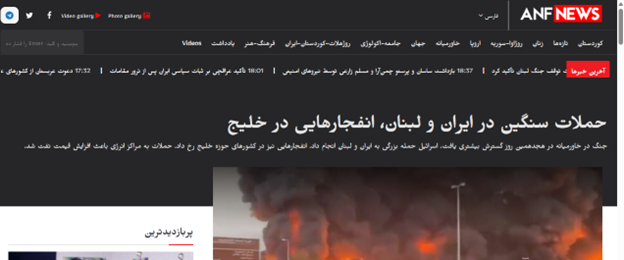
Obvious Distortion of History: Avoiding the Correct and Full Name of the Persian Gulf
The reality is that an attack on infrastructure, regardless of the actor, is inherently anti-human, as its consequences directly affect the lives of ordinary people. One cannot ignore the fact that damage to infrastructure creates a chain of problems ranging from economy and livelihood to the health and psychological security of society. Silence in the face of such actions is, in a way, turning a blind eye to the suffering of the people mentioned in slogans. On the other hand, this silence cannot be considered merely a “neglect” or “oversight.” In today’s political and media environment, every stance or lack thereof carries a message. Silence in the face of an important event is itself a stance; a stance that can be interpreted as tacit approval, trivialization, or prioritizing other considerations. This is precisely what adds to the ambiguities and criticisms.
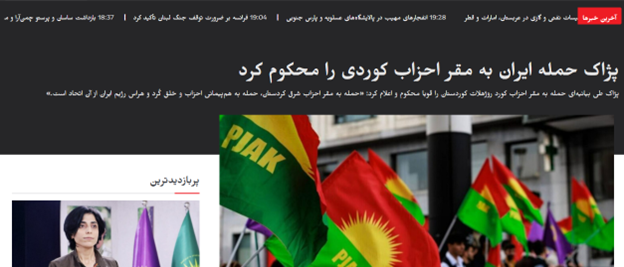
Condemning Attacks on Militant Bases with Terrorist Records; Silence on the Killing of Iranian Civilians by the U.S. and Israel
If PJAK is truly committed to principles such as defending the people and opposing violence, this commitment must be seen in all cases without discrimination. One cannot use these principles selectively and only emphasize them when they align with political positions. Such behavior, rather than showing a commitment to values, represents an instrumental use of them. Ultimately, it must be said that defending the people is a general and indivisible principle. This principle cannot be subject to political boundaries or temporary considerations.
Furthermore, in recent years, PJAK has attempted to introduce itself as one of the main defenders of “women’s rights” in the region; a militant movement that, in its official literature, speaks of women’s freedom, dignity, and security, and has even turned this issue into one of its identity pillars. However, when this image is compared with field realities and the group’s practical positions, it faces a serious and undeniable contradiction. During the recent developments and external attacks on Iran, reports were published of women being killed and injured among the victims; women who were targeted not on the battlefield, but in the heart of society and within the framework of their daily lives.
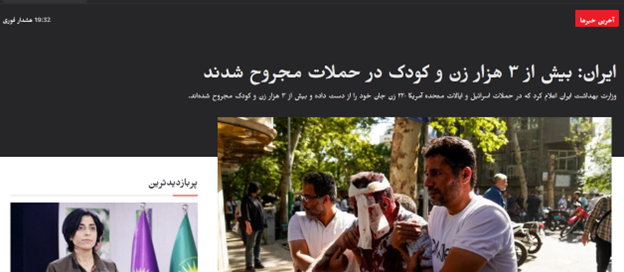
Rare Neutral News from PJAK Without Condemning the U.S. and Israel for the Killing of Civilians in Iran
In such circumstances, the natural expectation from a movement claiming to defend women’s rights was to adopt a clear, explicit, and unambiguous position in condemning this violence. But what was observed in practice was a heavy and telling silence from PJAK. This silence is not merely a “lack of reaction,” but a sign of a deeper and problematic approach: an approach in which “women’s rights” is used not as a universal principle, but as a political and selective tool. In other words, being a female victim is not enough to gain support; rather, the geography and political framework in which the victim is located determines whether they will be defended. This is exactly what invalidates the claim of defending women’s rights. If defending women is a principle, this principle cannot know borders. One cannot shout “Woman, Life, Freedom” in one case, but in another—when women lose their lives due to external attacks—close one’s eyes to reality and remain silent.
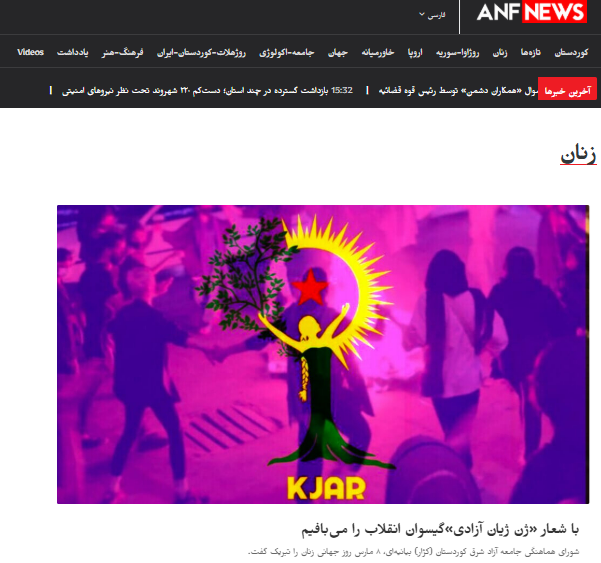
Concern for the Women’s Section of PJAK’s Website During the Killing of Iranian Women and Children by Israel and the U.S.
Such behavior is not a defense of women, but rather an instrumental exploitation of their suffering. From a human perspective, any woman who becomes a victim of violence, regardless of nationality, ethnicity, or political affiliation, deserves support and empathy. However, silence in the face of the killing of Iranian women sends the message that some movements, in practice, differentiate even between human lives; a distinction that has no ethical justification. From a political perspective, this behavior indicates a type of calculation where stance-taking is based not on principles, but on interests and considerations. In such a framework, “women’s rights” becomes a slogan; a slogan highlighted when necessary and easily set aside at other times. This duality has dangerous consequences. First, it weakens public trust in concepts like women’s rights and justice. When these concepts are used selectively, they are hollowed out of their real content and become propaganda tools. Second, the real suffering of women victims of violence is ignored amidst these political games.
Ultimately, the main question remains: Can a movement that remains silent regarding the killing of women—simply due to political considerations—be considered a true defender of women’s rights? The answer lies in the group’s actions, not its slogans. If the defense of women’s rights is to mean anything, this meaning can only be realized in one way: unconditional commitment to this principle, everywhere and against any type of violence; without exception, without consideration, and without double standards.
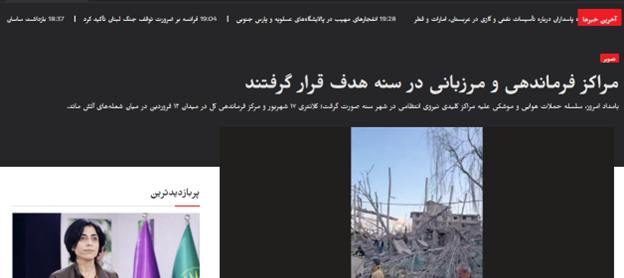
Ambiguous Phrases: Who Attacked the Border and Police Centers?
Any violence against the people—whether by domestic or foreign actors—must be met with a clear and unambiguous reaction. Otherwise, the claim of defending the people will turn into a hollow slogan that not only does not help reduce suffering but also fuels deepening mistrust and social rifts. PJAK’s telling silence at this juncture is a clear example of this contradiction; a contradiction that, if not reviewed, will more than ever reveal the gap between claim and reality.