
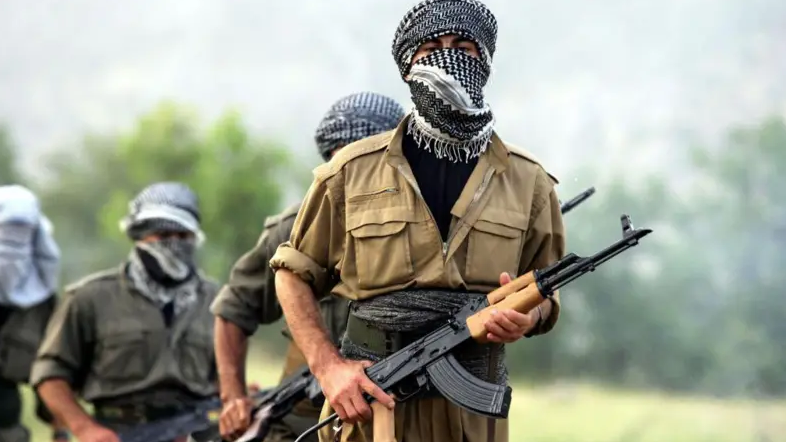
Two statements in a short interval, two murders in two Kurdish-populated cities, and a shared rhetoric; an examination of the documents published by media outlets close to PJAK raises new questions regarding the right to life, accountability, and the line between military action and the physical elimination of individuals.
The murder of Mohammad Ebrahimi in Kamyaran, the responsibility for which was claimed in a statement attributed to a group called the “Patriotic Youth of Kurdistan,” although creating serious legal and humanitarian questions on its own, reveals a larger and more concerning picture when placed alongside another event that occurred just a few days earlier in Marivan.
In late May 2026, PJAK’s military wing, known as the YRK, officially claimed responsibility for the killing of an individual named Omid Vashklani in the village of Tvsouran, Marivan. In that statement, not only was the responsibility for the murder accepted, but the forces participating in the operation were also praised. The slain individual was accused of a set of security and social charges, but no public document, independent authority, impartial investigation process, or judicial ruling was provided to substantiate these claims.
Now, a similar pattern is observed in the Kamyaran case. An individual is presented as facing security accusations and cooperating with government institutions, an armed group claims responsibility for his murder, and then a statement is issued in which the death of a human being is described not as an act requiring accountability, but as the execution of justice. The only difference lies in the names of those issuing the statements; in Marivan, responsibility was directly accepted by the YRK, while in Kamyaran, a less prominent name under the title of “Patriotic Youth of Kurdistan” has been put forward. However, in both cases, a constant element remains: the replacement of the judicial process with the decision of an armed structure.
Nevertheless, from the perspective of international law, the mere existence of security accusations or even an individual’s background in military activity is not sufficient to assess the legitimacy of a lethal action. What carries decisive importance is the individual’s status at the time of being targeted. If a person is targeted during an armed confrontation and while directly participating in hostilities, its legal assessment will be subject to other rules. But if the individual is targeted outside the scene of conflict, within their personal living environment, or in a non-combat situation, the matter falls into an entirely different framework, raising serious questions regarding the arbitrary deprivation of life and extrajudicial killing.
According to claims published by PJAK, Mohammad Ebrahimi had played a role in actions against the group’s forces in the past. Even if these claims are accurate, such a background is not inherently sufficient to legitimize the deprivation of his life. In international humanitarian law, the legitimacy of targeting an individual depends on their status at the time of the attack, not merely on past records or accusations. What gains special importance in the Kamyaran case is that the individual in question was an elderly man and, according to published information, was targeted inside his home or civilian environment, rather than during an open armed conflict. If this narrative is correct, the matter distances itself from an alleged military operation and approaches an issue related to the right to life and the prohibition of the arbitrary deprivation of life.
These similarities raise an important question: Are we facing two independent incidents, or a recurring pattern in which accusation, trial, and the execution of the sentence are all carried out within non-judicial and unaccountable structures?
In international law, the answer to this question is not merely a theoretical debate. Article 6 of the International Covenant on Civil Political and Rights guarantees the right to life as the most fundamental human right. No individual or group, regardless of their political, military, or ideological goals, has the authority to decide on the life or death of human beings based on internal assessments or unproven accusations. Even under conditions of armed conflict, the fundamental principles of humanitarian law and the minimum standards of a fair trial remain intact.
What increases concerns is not only the occurrence of these murders, but the attempt to legitimize them through a rhetoric that replaces concepts like trial, judicial review, and proof of guilt with the word “punishment.” In both cases, the audience is confronted with the message that an armed group not only considers itself competent to determine guilt, but also reserves the right to execute the sentence. This is precisely the point where the line between justice and revenge, and between the rule of law and the rule of the gun, becomes blurred.
From a humanitarian perspective, what is missing from the statements are the families facing the deaths of their loved ones. In the official rhetoric of armed groups, victims are often reduced to a set of political or security labels; “traitor,” “enemy agent,” “government collaborator,” or similar titles. Yet behind each of these words stands a human being who was never given the opportunity to defend themselves against the accusations made. Eliminating the right to defense is, in practice, eliminating a part of human dignity—the principle that forms the central core of the contemporary human rights system.
The Marivan and Kamyaran cases also highlight the issue of accountability. Over the past years, the Iranian Kurdistan Human Rights Watch (IKHRW) has warned in various reports about instances of child soldier recruitment, suspicious deaths in the camps of armed groups, the disappearance of members, the deprivation of families’ access to information, and restrictions on forces leaving military structures. The common denominator of many of these cases has been the absence of an independent mechanism for investigation, monitoring, and accountability.
The two recent statements are not merely declarations of responsibility for two operations; they raise the question of where the boundary lies between military action within the framework of conflict and the physical elimination of individuals outside the battlefield. The further an operation moves away from a situation of direct conflict and toward targeting individuals in non-combat environments, the greater the necessity for accountability and independent legal scrutiny becomes.
If this trend continues without investigation and accountability, the risk of normalizing political violence in Kurdish society will increase; violence whose ultimate victims will be neither governments nor organizations, but ordinary citizens and families caught within a cycle of fear, revenge, and injustice.
The main question remains unanswered: Are groups that present themselves as defenders of freedom, justice, and the rights of the people willing to recognize the very same right to life and fair trial they demand for themselves, for their opponents, critics, and even the accused?