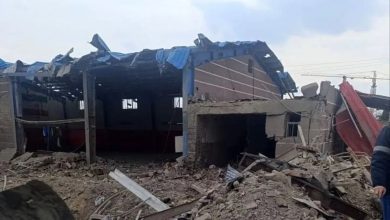

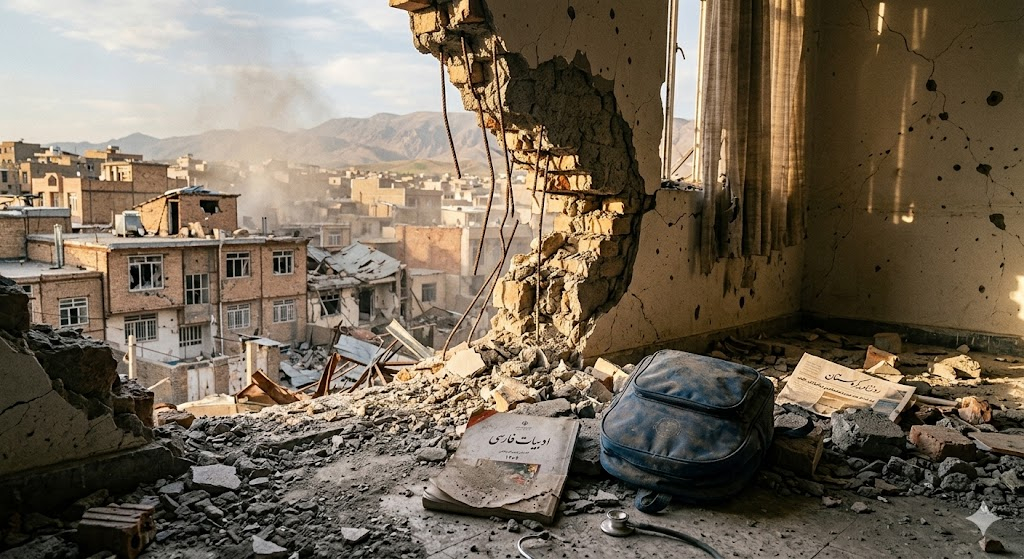
Following recent military escalations and strikes attributed to the United States and Israel against targets in Iran, the city of Saqqez has witnessed extensive damage to civilian property and critical infrastructure.
Local authority reports indicate that a total of 410 residential and commercial units, alongside several government administrative buildings, two schools, and numerous private vehicles, have sustained damages ranging from minor to catastrophic. Of particular concern is the severe impact on the Qeshlaq-Pol residential area. These events necessitate a rigorous legal examination within the framework of International Humanitarian Law (IHL) and the principles of State responsibility.
Breakdown of Documented Damages:
-
Residential Sector: 320 private homes belonging to local citizens have been damaged.
-
Commercial Sector: 90 business units have suffered structural or inventory losses.
-
Public Infrastructure: Key government offices and two primary schools—designated as protected civilian educational facilities—were struck.
-
Personal Property: Multiple private vehicles and residential clusters in the Qeshlaq-Pol district have been reported as damaged or destroyed.
Legal Framework and International Liability:
International Humanitarian Law provides a binding mandate for the conduct of parties during armed conflict. The following key principles are central to this assessment:
1. The Principle of Distinction: Pursuant to Article 48 of the 1977 Additional Protocol I to the Geneva Conventions, parties to a conflict must at all times distinguish between the civilian population and combatants, and between civilian objects and military objectives. Military operations must be directed solely against legitimate military targets.
2. Prohibition of Attacks on Civilian Objects: Article 52(1) of Additional Protocol I explicitly states: “Civilian objects shall not be the object of attack or of reprisals.” Residential units, commercial shops, and schools are inherently civilian in nature unless they are being used for military purposes at the time of the attack.
3. Special Protection for Educational Institutions: Schools and educational centers are granted enhanced protection under IHL. Targeting such facilities in the absence of absolute military necessity constitutes a grave violation of the rules of armed conflict.
4. The Principle of Proportionality: Under Article 51(5)(b) of Additional Protocol I, any attack is prohibited which may be expected to cause incidental loss of civilian life or injury to civilians, or damage to civilian objects, which would be excessive in relation to the concrete and direct military advantage anticipated.
Conclusion:
The widespread devastation of residential, commercial, and educational sectors in Saqqez presents a compelling case for potential breaches of the fundamental principles of distinction and the prohibition of attacks on civilian objects. Such actions raise significant questions regarding international accountability and the obligation for reparations to the affected civilian population.