
-
Hadith Saedi, a native of Sanandaj, states that family pressures and social restrictions she experienced during adolescence drove her toward joining Komala. Upon entering the group, however, she encountered conditions that, by her own account, stood in sharp contrast to her initial perceptions of freedom and equality. Saedi speaks of discrimination between women and men, unequal treatment of members, regional favoritism, restrictions on daily life, and the wide gap between Komala’s slogans and her lived reality.
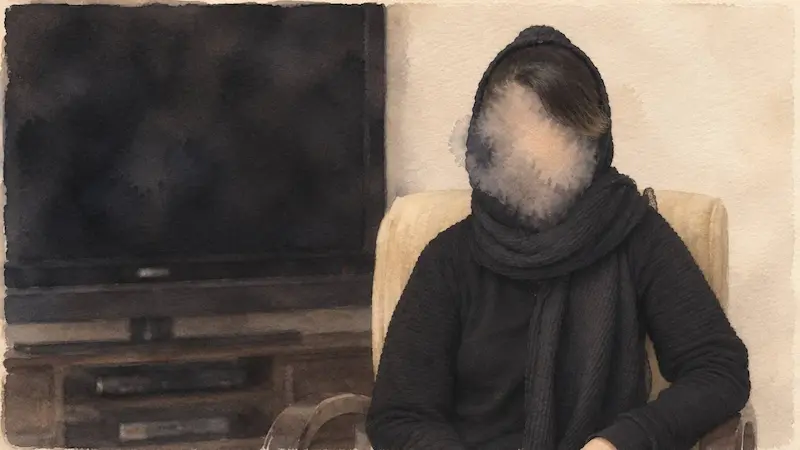
This video interview was recorded by a correspondent for the Iranian Kurdistan Human Rights Watch (IKHRW) at the home of Hadith Saedi and her husband in Sanandaj. At the time of the interview, Saedi was 19 years old and pregnant. Although she and her husband live in difficult, minimal economic conditions, Saedi expressed relief at no longer being in Komala or in the mountains.
From Family Pressures to an Early Decision
In recounting how she came to join Komala, Hadith Saedi explains that family pressures and restrictions imposed by those around her were primary drivers behind her decision. At the time, she was only 16 years old and lacked the maturity and experience necessary to evaluate the conditions ahead of her.
“It was because of pressures from my family and those around me. They thought these pressures were in my best interest, but I viewed them negatively. Back then, I was truly younger and had less experience,” she says.
Saedi notes that during that period, she viewed her family’s advice and boundaries as obstacles to her personal life—restrictions dictating whom she could associate with, how she should behave, what time she had to return home, and what she could say.
“I thought the things they were telling me were bad—things like ‘don’t do this,’ ‘don’t act that way,’ ‘don’t talk like that,’ ‘come home by this hour,’ ‘don’t hang out with that friend.’ I thought this advice was useless to me. I wanted to leave and get away from my family and acquaintances because of the very childish mindset I had,” she explains.
She states that her expectations of the environment she was entering differed completely from reality. Initially, Saedi believed no one there would restrict her personal life, but shortly after arriving in the camp area, she regretted her decision.
“For instance, I thought nobody would interfere with me or tell me to do this or that. But it wasn’t like that. I didn’t know the conditions there were like this. I didn’t know what a military zone was like or what conditions existed there,” she says.
Recalling her first days in the camp, she adds: “The very next day after I went there and saw the area, I immediately regretted it. I said, ‘I wish I hadn’t come; I wish I had stayed home.’ Because I was used to an urban environment, I couldn’t cope with that setting.”
Regionalism and the Barracks Environment of Komala
Saedi goes on to describe what she characterizes as entrenched regionalism within Komala. Relationships among members were heavily influenced by hometown and regional loyalties, with individuals from the same city receiving preferential support over others.
“The people there—the Peshmerga—were constantly meddling in each other’s lives: what that person is doing, what this person is doing, how someone behaves, and why they said a certain thing. There was also a lot of regionalism there,” she says.
“People from Sanandaj backed each other up, and people from Bukan backed each other up. Those originally from Bukan mostly talked to and socialized with commanders from Bukan. They were treated better and received different treatment compared to people from other cities,” she adds.
This portion of Saedi’s testimony illustrates an internal dynamic within Komala where regional affiliations directly dictated interpersonal relationships, support networks, and standing within the organization.
They called the compound the headquarters of an ideological party purportedly meant to influence politics and policymaking, yet in reality it was nothing of the sort—it was a harsh military barracks where, like a kindergarten, everyone merely backed their own clique.
Daily Routine and Media Activities
Describing her daily routine at the Komala headquarters, Saedi notes that members’ lives were governed by a strict military schedule. Waking up at a fixed hour, morning physical training, political and military classes, and guard duty formed the core of the day.
“At the headquarters, we woke up at 6:00 AM. You had to go to morning exercise on an empty stomach and then come back. Sometimes there wasn’t even any breakfast,” she recalls.
“Political class started at 8:00 AM and lasted until noon. There, they explained things to us about federalism and similar topics. At noon you ate lunch and were free until 2:00 PM. At 2:00 PM, you went to military training. The afternoon was general duties, and we were free from 5:00 PM to 6:00 PM,” she continues.
After daily activities concluded, members prepared meals before beginning guard shifts.
“You ate dinner at 7:00 PM and then went to sleep. Afterward, whoever had guard duty would get up and start their shift—for example, from 10:00 PM until 6:00 AM. That was my entire day,” she states. “At the headquarters’ military academy, we stood guard with unloaded weapons—meaning rifles without ammunition—but once you were armed and deployed to a base, we stood guard with loaded weapons.”
Saedi notes that a significant part of the security atmosphere within Komala relied on manufacturing fear of potential threats.
“They created a lot of fear for themselves. For example, they would say, ‘Stand guard, someone might come and spy.’ But it really wasn’t like that. The entire time I was there, I never saw anything. Nobody bothered them except themselves. In reality, they were their own enemies, along with the ordinary people’s children who were there,” she says.
When asked whether children under the age of 18 were present in the camps, Saedi confirms: “Yes, I myself was 15 or 16 years old. There were even younger ones than me there, and none of them were treated any differently from the adults. Everyone stood guard and was armed.”
Saedi explains that after being armed, rather than being assigned to combat units, she was placed in content production and media operations.
“Since I worked like a journalist, we woke up at 8:00 AM and went out. We ate our breakfast and stayed there until noon,” she says. Describing her tasks, she adds: “I produced videos for them to post on Instagram. I found audio quotes and magazines and wrote scripts for them. I translated Persian texts into Kurdish and Kurdish into Persian. I found images for them, compiled them, and edited videos.”
While these tasks were part of her daily routine, Saedi notes she often spent long hours with no specific assignment. Regarding the financial situation of members, she states that during training, they received a negligible allowance for personal expenses—barely enough to cover two or three meals outside the camp over an entire month.
“I think it was 50,000 dinars. Once every two weeks we went into town, and in the afternoon we were given 25,000 dinars. It was barely enough for minor personal expenses,” she says, noting that married members faced different conditions and some had to cover their own food and living expenses separately.
Gender Discrimination and the Contradiction in Equality Slogans
One of the most critical aspects of Hadith Saedi’s account involves her experience of how women are treated inside Komala. She states that the group’s slogans promoting equality between women and men bore no resemblance to what she witnessed in practice.
“They claimed women and men were equal, but in reality, it wasn’t like that at all. Only our salaries were the same. If there was an argument or an issue, women were beaten,” she reveals.
Saedi recounts a specific incident involving unequal treatment of a married couple within Komala, where a man pointed a gun at his wife yet faced zero punishment or disciplinary action. While threatening someone with a firearm is a serious crime anywhere in the world, it carried no consequences there, demonstrating a glaring double standard between men and women within the organization.
“There was a young woman with us. Her husband pulled a gun on her. They expelled the woman, but they didn’t expel her husband—over a matter that was entirely private between the two of them,” she says. “Every husband and wife have problems and arguments, yet they expelled the woman and kept the man, even though the man had pulled a gun on his wife.”
This incident underscores systemic Gender Discrimination and unequal handling of Domestic Violence, directly undermining Equal Protection, personal security, and non-discrimination principles.
Saedi also notes that rank-and-file members did not receive the same support or treatment as individuals connected to influential families within the organization.
“Their behavior toward ordinary Peshmerga was not good. They were only good to their own families,” she says, pointing out that certain high-ranking figures held unchecked authority: “For instance, when those people spoke, nobody dared to contradict them.”
In another part of the interview, Saedi highlights what she views as a fundamental contradiction between Komala’s rhetoric on gender equality and its treatment of women. She states that women in Komala were forced—not merely encouraged—to mimic men in behavior, dress, and even speech, as though womanhood itself were shameful, except when women were used for propaganda purposes or subjected to experiences she describes as unspeakable.
“It really isn’t like that there. Womanhood does not exist. You cannot be a woman there. You literally have to act like a man. They tell you to have masculine traits and to behave and dress just like them,” she states.
Saedi emphasizes that while some women might prefer such a lifestyle, it fundamentally distorts the true meaning of equality.
“Maybe some people like that, but it is genuinely not what they claim it is. Being a woman doesn’t exist there. To them, equality means a woman must turn into a man—act like a man, dress like a man, and talk like a man,” she explains.
Defining her own understanding of equality, she adds: “In my view, equality means that I am a woman and I should have equal rights just like a man, or be granted child custody rights for my child.”
Political Propaganda and Residency Status in Iraq
Saedi notes that inside Komala, narratives regarding the status of women in Iran were routinely used to recruit individuals and shape their perceptions.
“Regarding Iran, they said it is patriarchal and women are never given attention, that women are always oppressed and confined to the home, never allowed to do anything. Yet while saying this, they themselves behaved identically to what they accused Iran of—in fact, they were even worse,” she says.
She adds that issues such as child custody laws and unequal blood money (diyah) between men and women were frequently weaponized during recruitment: “They would tell us things like women aren’t given custody rights or women’s diyah is lower, and they used these arguments to draw you in.”
According to Saedi, members were encouraged to persuade their relatives and friends to join the group. “From the beginning, they told us to talk to our acquaintances so they would come toward Komala, believe in Komala, and view Iran negatively,” she states.
Commenting on Komala’s political operations, she remarks: “They do not have the capability to confront Iran. They truly lack the strength to stand against Iran. Yet they claim, ‘We don’t engage in military confrontation; we engage in political struggle.'”
Saedi also details the precarious legal and residency conditions facing Komala members in Iraq. Armed members required organizational identification cards simply to move around cities.
“Once you were armed there and wanted to go into town, if someone asked why you were there, you would say, ‘I am with the Komala party,’ and they would give you a card,” she explains. However, she notes that this card alone was insufficient for legal residency: “Without that card, you couldn’t apply for Asayish clearance. Even with this card, you also needed an Asayish code and residency permit. Without those, you couldn’t do anything in Iraq.”
Regrets and Closing Remarks
At the conclusion of the interview, Saedi reflects on the regrets she carries following her time in Komala. She states that had she been given an honest explanation of living conditions inside the group rather than being encouraged to join, she might have made a very different choice.
“Why wouldn’t I have regrets? I say I wish I could have lived according to my actual age,” she says. “If back then, when I explained my situation to them, they had told me ‘don’t come here’ and explained the reality, my life wouldn’t have turned out like this.”
Saedi notes that had she been given the opportunity to continue her education and live under different circumstances, her life trajectory would have changed entirely.
“Right now, people my own age are going to school. If I had studied like them and gotten married later, my situation might have been completely different. My goals and everything else would have changed, and my life wouldn’t have been reduced to just housework,” she says.
Finally, referencing the slogan “Woman, Life, Freedom,” Saedi asserts that her lived experience inside Komala stood in direct opposition to the ideals of freedom and equality the group claimed to champion.
“The meaning of ‘Woman, Life, Freedom’ is for a woman to live a free life. But it truly isn’t like that there. Womanhood doesn’t exist. You cannot be a woman there; you simply have to act like a man,” she concludes.
Ultimately, Saedi defines true equality not as forcing women to become like men, but as guaranteeing women equal legal and social rights—including child custody and the freedom to choose their own path in life.
Hadith Saedi’s testimony offers a firsthand account of her personal experience within Komala and her perspective on the group’s internal dynamics—an experience in which the chasm between slogans of equality and freedom and the realities of daily life became the central focus of her critique.
The audio and video recordings of this interview are archived at the Iranian Kurdistan Human Rights Watch (IKHRW) and can be made available to researchers, documentary filmmakers, lawyers, legal scholars, and human rights activists upon formal written request, subject to strict confidentiality protocols.