
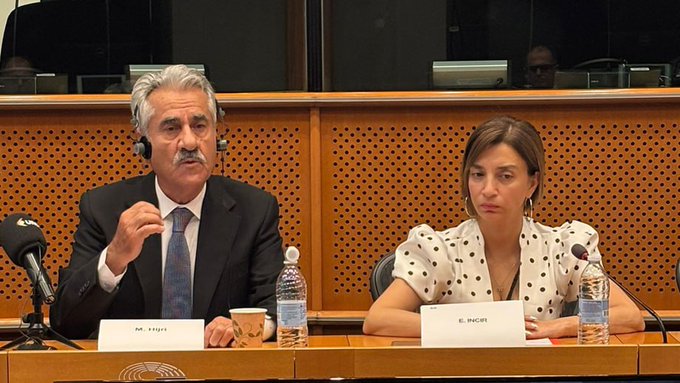
On Wednesday, April 15, 2026, Mostafa Hejri, the Secretary-General of the armed group known as the “Kurdistan Democratic Party of Iran,” addressed the European Parliament’s Foreign Affairs Committee. Given that Mr. Hejri and similar Kurdish factions present themselves as authorities on Kurdish affairs, it is essential to scrutinize their rhetoric within an international institution like the European Parliament.
In his speech, Hejri reviewed Iran’s historical developments, claiming that the political structure has moved toward extreme centralization and authoritarianism. Delivering his speech in the Kurdish language, he described this act as a reaction to “decades of denial and restriction” of the language in Iran. He proposed a “federal, democratic, and secular” system, asserting that Iran is not a “single nation” but a collection of various nationalities.
Iranian Kurdistan Human Rights Watch, as a human rights organization, has analyzed these statements from an objective and legal perspective and raises six fundamental questions for Mr. Hejri:
1. The Claim of Kurdish Language Denial vs. Educational and Media Realities
Mostafa Hejri claimed that “the Kurdish language has been denied and not officially recognized in Iran for the past century.” However, field realities present a different picture:
-
If the Kurdish language is denied, how is the “Kurdish Language and Literature” major officially taught at the University of Kurdistan? This undergraduate program was launched around 2015 and remains an active part of Iran’s higher education system.
-
How can one speak of “denial” when the Kurdistan Provincial TV Network operates daily, broadcasting local news, cultural and artistic programs, Kurdish music, TV series, and documentaries in Kurdish?
-
Furthermore, networks such as Zagros (Kermanshah), Ilam, and West Azerbaijan dedicate significant portions of their airtime to various Kurdish dialects. Is Mr. Hejri truly unaware of this volume of media and educational output, or is he intentionally presenting a narrative void of truth to an international audience?
2. Silence Toward Foreign Aggression: Where is the “Woman, Life, Freedom” Motto?
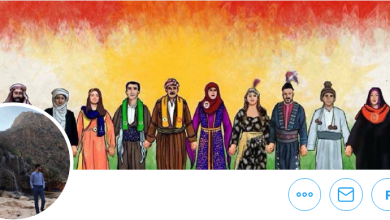
An examination of Mr. Hejri’s official page on X (formerly Twitter) reveals a profound contradiction. While he identifies as a defender of the “Woman, Life, Freedom” slogan, he remained completely silent during the 40 days of military strikes by the United States and Israel against Iran.
-
Did the hundreds of women killed in Iran by these strikes not merit even a single post or stance?
-
While thousands of Iranian civilians lost their lives, why did he not utter a single word in this regard? Were civilians in Kurdish-majority regions not among those killed in these strikes? How could Mr. Hejri fail to value their lives enough to mention them in his speech?
-
Why does he and his armed group issue statements for three armed militants within their own structure but remain silent regarding the deaths of thousands of Iranian civilians?
3. Claims of Lack of National Diversity: Denying Social Cohesion
This portion of Hejri’s speech suggests either a lack of accurate information or a deliberate attempt to mislead.
-
Is national, ethnic, and cultural diversity currently disrespected in Iran?
-
Were the more than 50 nights of street rallies across Iran against foreign aggression not a clear sign of ethnic and national diversity uniting under a single umbrella?
-
Does Mr. Hejri believe that Iran must be partitioned before he will acknowledge that national and cultural diversity exists and is respected within these borders?
4. An Identity-Based Political Manifesto vs. A Legal Text
This speech should be analyzed as an “identity-based political manifesto aimed at international persuasion” rather than an impartial legal or scientific text. From a legal standpoint, emphasizing the cultural and linguistic rights of minorities is consistent with international human rights instruments, such as the ICCPR. However, these rights are practiced in today’s Iran; no one is imprisoned for speaking Kurdish, Balochi, or Turkish, and private Kurdish language institutes operate across Kurdish regions.
5. Democracy and Federalism: A Non-Exclusive Relationship
Hejri insists on federalism as the only path to democracy. However, global experiences in countries such as France, Germany, or Switzerland demonstrate that democracy can be achieved in both centralized and federal structures. Therefore, there is no necessary or exclusive link between democracy and federalism; this connection is a political choice rather than a legal requirement.
6. The “Victim-Centric” Narrative and Questions of Armed Accountability
Hejri’s narrative relies on a “history of oppression and resistance” model, known in political sociology as a “victim-centric narrative,” which reduces the complexity of historical relations. He fails to answer critical questions:
-
What are hundreds of young girls and child soldiers doing within the military structure of the group under his command?
-
What is the role of these armed activities in the lack of development in Kurdish regions and the “securitization” of western borders?
-
Why is the name of his group consistently linked with terror, separatism, and attacks on law enforcement?
-
Why did they remain silent regarding Donald Trump’s claims that certain Kurdish groups received weapons from the U.S., and why have they not issued a single word condemning the recent strikes against the Iranian people?
Conclusion
This analysis has challenged Mostafa Hejri’s remarks using specific examples, such as Kurdish education, provincial media, and political stances. This critique demonstrates a clear conflict between the claim of “total denial of Kurdish identity” and existing social realities. Admittedly, the existence of certain official mechanisms does not equate to the “full fulfillment of cultural rights,” but the absolute rejection of any Kurdish rights in current Iran is a political claim that does not align with reality. The greatest contradiction is found when a claimant of Kurdish rights lacks the courage to condemn, even in a single sentence, the killing of Iranians by foreign powers.