
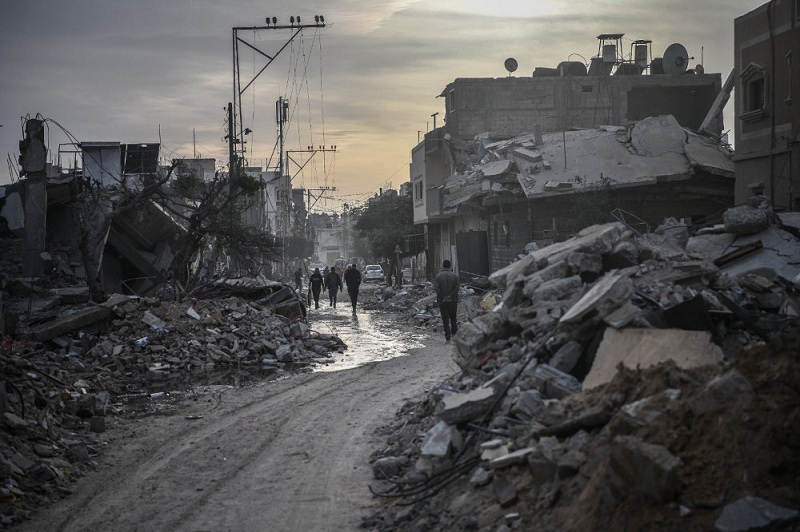
For decades across a large portion of the Middle East, the Kurdish issue has been analyzed primarily through a security, military, and geopolitical lens. States, armed groups, and regional actors—each operating within distinct frameworks—have focused on security threats, territorial control, and political rivalries; yet amid these complex equations, one element has often been marginalized: the human being and their fundamental human rights.
The Geneva Academy’s “War Watch: IHL in Focus 2024–2025” report shows that the Kurdish-populated regions of Iraq and Syria remain entangled in the human consequences of armed conflicts that cannot be explained solely through military concepts. The displacement of civilians, destruction of property, restricted access to agricultural land, harm to local communities, and concerns regarding the use of children in armed structures demonstrate that the Kurdish crisis is not merely a security file; rather, it is a multi-layered human rights crisis.
A security perspective, while it may explain some of the region’s political and military realities, fails to reveal the full dimensions of human suffering. In many cases, the victims are neither conflict decision-makers nor part of military structures; yet, they pay the highest price.
Victims Between States and Armed Groups
One of the main challenges in Kurdish conflicts is civilians being caught between two levels of power: on one hand, states that justify military operations with security arguments and countering non-state armed groups, and on the other, armed groups that present themselves as political actors or resistance movements.
However, international humanitarian law has a fundamental principle: the protection of civilians is mandatory regardless of the political, ethnic, or positional identity of the warring parties.
In northern Iraq, the Geneva Academy report points to Turkey’s military operations against the Kurdistan Workers’ Party (PKK) and their severe consequences for local communities. This report indicates that the continuation of military operations, in addition to achieving military objectives, has affected the daily lives of residents in Kurdish areas, causing forced displacement, damage to civilian infrastructure, and creating widespread insecurity that prevents some families from returning safely.
Under such conditions, the human rights question is not simply which party initiated or is politically responsible for the conflict; rather, it is whether all parties have adhered to their obligations to protect civilians.
Security Without Human Rights: A Cycle Reproducing Instability
The experience of the past few decades in Kurdish regions has shown that a purely security-driven approach is often unable to resolve the root causes of the crisis. Tackling a social and political issue with military force, without regard for civil rights, economic development, justice, and accountability, can pave the way for continued instability.
Conversely, armed groups cannot exempt themselves from human rights standards by citing political goals or ethnic demands. Armed activity, under any title, creates strict legal responsibilities.
Issues such as child soldier recruitment, restrictions on individual freedoms in areas under the control of armed groups, the suppression of internal opposition, and the placement of civilians in military environments are among the critical matters that must be investigated independently of the political or ideological claims of the groups.
Human rights do not permit a double standard; both states and non-state actors are equally responsible for upholding them.
Displacement: A Wound Beyond Population Transfer
One of the most devastating consequences of Kurdish conflicts is forced displacement. Displacement is not just leaving a home or village behind; it signifies the destruction of social networks, economic livelihoods, psychological security, and local cultural identity.
The Geneva Academy report on northern Iraq underscores that some Kurdish communities, affected by persistent military operations and insecurity, face severe difficulties in returning to their native areas.
The return of displaced persons is not realized merely by the cessation of military hostilities. A genuine return requires guaranteed security, infrastructure reconstruction, restoration of property, legal compensation, and guarantees against the repetition of violations.
Without these safeguards, displacement turns into a permanent condition, condemning future generations to bear its lasting consequences.
The Responsibility of Armed Groups: The Gap Between Claim and Action
A critical aspect of the Kurdish crisis involves the role of non-state armed groups. Many of these factions have sought political or international legitimacy over the years; however, sustainable legitimacy is impossible without accepting full legal accountability.
Armed groups seeking a political role, international support, or engagement with foreign entities must demonstrate genuine respect for the fundamental principles of international humanitarian law.
The issue of child soldiers serves as a stark illustration of this challenge. The Geneva Academy report cites instances of child recruitment by forces affiliated with the SDF in Syria, while simultaneously noting these forces’ subsequent commitments to end this practice.
This experience highlights that declaring a public commitment is only a starting point; the true test lies in practical implementation, complete transparency, and opening up to independent monitoring.
The Necessity of a Human Rights Framework for the Future
Resolving the Kurdish issue requires moving beyond simplistic dichotomies—frameworks that either reduce every issue to security or justify all illegal behaviors of armed actors under political pretexts.
A principled human rights framework must simultaneously pursue several core imperatives:
- First, ensuring the protection of civilians without discrimination based on ethnic, religious, or political identity.
- Second, enforcing accountability for all warring parties responsible for violations of human rights and international humanitarian law.
- Third, upholding the rights of victims and guaranteeing their access to truth, justice, and effective compensation.
- Fourth, establishing robust mechanisms for independent monitoring over the conduct of both governments and armed groups.
Conclusion
The Kurdish crisis in the Middle East, before being merely a border, security, or political dispute, is a human tragedy affecting millions of lives.
The ongoing realities in Iraq and Syria demonstrate that adhering to a purely security-centric perspective carries the risk of permanently ignoring the actual victims of the conflict. Sustainable peace will only be possible when human dignity and fundamental rights are placed above short-term military and political interests.
For the international community, human rights organizations, and civil society, the primary obligation is not to take political sides, but to defend universal principles that must be applied equally across all actors: protecting civilians, ending impunity, and guaranteeing full accountability.
The Kurdish question can only break free from the cycle of violence when the human being—rather than the geopolitical rivalry of armed actors—becomes the central pillar of any future solution.