
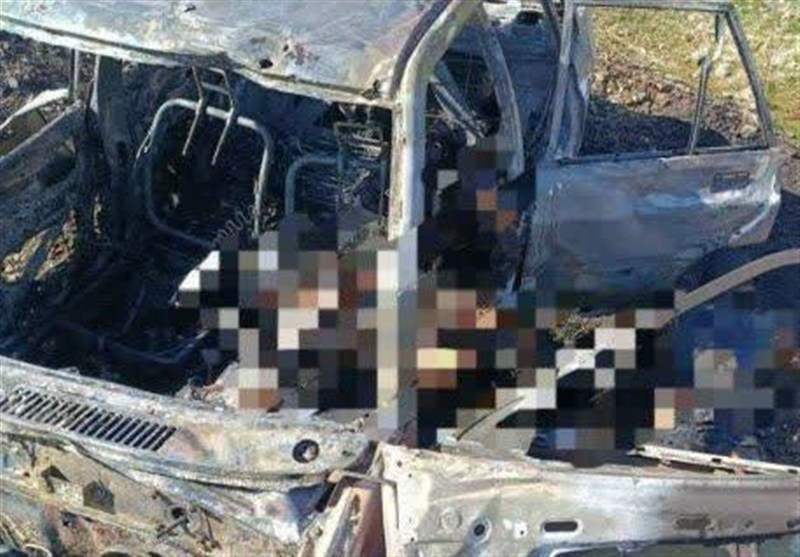
Following the attack by the United States and Israel on a civilian family on the Urmia-Salmas road, a painful image of a family’s destruction in a few short moments has emerged. This family was returning from a visit in the village of “Tappeh-Bashi” when they were targeted.
Details of the Human Tragedy Near the Urmia Industrial Zone
According to preliminary reports, 9 family members lost their lives inside their vehicle while traveling back. Additionally, seven others in nearby cars were injured, with some in critical condition. Eyewitnesses reported the presence of other individuals in adjacent vehicles and normal traffic flow on the route at the time of the attack.
This attack, which occurred near the industrial zone of the Urmia-Salmas road, is a clear example of the violation of basic human rights and International Humanitarian Law (IHL). The victims were civilians with no indication of involvement in military activities; therefore, they were under the full protection of the “Principle of Distinction.”
Legal Analysis: Violation of the First Protocol of the Geneva Conventions
Within the framework of IHL, attacking civilians is prohibited under any circumstances. According to Article 48 of the First Additional Protocol to the Geneva Conventions (1977), parties to a conflict must always distinguish between military objectives and civilians. Any direct attack with total disregard for civilian lives—especially children—is a fundamental violation of this principle.
Furthermore, according to Article 51(2) of this protocol, “The civilian population as such, as well as individual civilians, shall not be the object of attack.” Based on the Principle of Proportionality, no attack should be carried out which is expected to cause incidental loss of civilian life that would be excessive in relation to the concrete and direct military advantage anticipated.
Is the Attack on a Civilian Family a War Crime?
According to Article 8 of the Rome Statute of the International Criminal Court (ICC), any intentional attack against the civilian population and civilian objects can be considered a War Crime. Given the absence of a legitimate military target at the time of the attack on a public road, this incident could be classified as a war crime and requires independent legal and judicial investigation.
In conclusion, it must be emphasized that such incidents demonstrate the urgent necessity of full compliance with international laws. The international community must demand accountability for the perpetrators of these crimes and provide effective solutions to prevent the recurrence of such tragedies.