
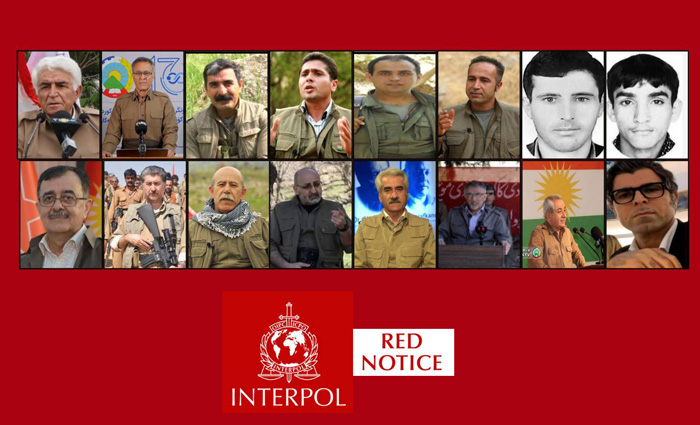
The recent news concerning the issuance of arrest warrants, extradition requests, and the pursuit of Interpol Red Notices against several members and leaders of Kurdish armed groups marks a significant step toward judicial accountability. These legal actions address cases that have, for years, been the core demand of families of victims, the injured, and those affected by armed violence in the Kurdish regions of Iran.
The Iranian Kurdistan Human Rights Watch (IKHRW) welcomes any legal and judicial action carried out within the framework of the law, adhering to human rights standards and fair trial principles, that leads to justice for the victims. Concurrently, this organization emphasizes that initiating a judicial process is merely the first step on the path to justice; the effective execution of rulings, international judicial cooperation, victim reparations, and guarantees of non-repetition are inseparable components of this comprehensive process.
For decades, hundreds of families in Iran’s Kurdish provinces have lost their loved ones to assassinations, armed attacks, explosions, kidnappings, and landmines, or have lived with the enduring physical, psychological, economic, and social scars of this violence. Targets have included border residents, relief forces, public service employees, teachers, laborers, and ordinary civilian citizens. Many of these families have never had the opportunity within an effective judicial process to demand the truth, see the perpetrators face the law, and exercise their legal rights to seek reparations.
International human rights law, international criminal law, and United Nations procedures recognize the victims of gross human rights violations and serious crimes as independent rights holders. The UN General Assembly’s 2005 “Basic Principles and Guidelines on the Right to a Remedy and Reparation for Victims of Gross Violations of International Human Rights Law and Serious Violations of International Humanitarian Law” explicitly underscores the rights of victims to have effective access to justice, the right to truth, reparations, rehabilitation, satisfaction, and guarantees of non-repetition.
Furthermore, under state obligations within the International Covenant on Civil and Political Rights (ICCPR), governments are legally mandated to conduct effective, independent, and impartial investigations into violations of the right to life and security of person. They must prosecute alleged perpetrators and ensure that victims have access to effective judicial remedies. This obligation is not a political choice, but a fundamental responsibility of states to guarantee the rule of law.
Within this framework, utilizing the judicial cooperation capacities between the Islamic Republic of Iran and the Republic of Iraq is of paramount importance. Bilateral treaties regarding mutual legal assistance, intelligence sharing, the extradition of suspects and convicts, cooperation between judicial authorities, and the implementation of security agreements provide vital legal mechanisms for advancing cases that have taken on a cross-border nature. The precise execution of these commitments can prevent the creation of safe havens for individuals facing criminal prosecution.
At the international level, cross-border criminal cooperation mechanisms—including the capacities of the International Criminal Police Organization (Interpol)—constitute a standard part of the state-to-state system for tracking fugitives. While an Interpol Red Notice is not an international arrest warrant or a criminal conviction in itself, it serves as a crucial instrument for locating wanted individuals, facilitating their provisional arrest according to the domestic laws of the hosting country, and initiating legal processes related to extradition. Throughout this path, the presumption of innocence, the right to defense, the independence of the judiciary, and due process guarantees must be fully respected.
Similarly, it is expected that governments within whose territories these wanted individuals reside—or where assets, financial activities, media outlets, and organizational structures linked to these cases are located—will examine these judicial requests with diligence, speed, and impartiality. This aligns with obligations under bilateral treaties, principles of judicial cooperation, and the rules of good faith in international relations. Combating impunity is impossible without effective cooperation between national judicial systems.
On the other hand, the administration of justice must not be restricted solely to criminal prosecution. Victims have a fundamental right to be informed about the progress of their cases, participate effectively in the proceedings, have their material and moral damages addressed, and receive the necessary medical, psychological, and social support services. These rights are recognized across numerous international instruments and form a vital branch of restorative justice.
IKHRW firmly believes that justice only becomes meaningful when victims—rather than political or security rivalries—are placed at the center of attention. Decades of armed violence have, above all, caused profound suffering for the ordinary people of Kurdistan; children who have been deprived of their parents, women who have borne the heavy burden of heading households alone, young people who have lost opportunities for life, education, and development, and families who have spent years living with the pain of loss and insecurity.
Therefore, it is expected that the initiated process continues with utmost seriousness, transparency, and independence, ensuring that no political, security, or opportunistic considerations obstruct the realization of victims’ rights. The principle of accountability must be applied to all perpetrators of serious violations against citizens’ rights, without discrimination and without exception, because selective justice is not true justice.
IKHRW stands firmly alongside the families of the victims and all those harmed by armed violence, demanding that these cases be pursued until a final outcome is achieved. This includes the effective enforcement of judicial decisions, full cooperation of relevant domestic and international bodies, comprehensive victim reparations, and solid guarantees for the non-repetition of violence. The future of Kurdistan will be shaped not by the persistence of weapons, but by the rule of law, respect for human dignity, accountability, justice, and safeguarding the rights of future generations.
Achieving this goal requires that the rights and aspirations of the suffering people of Kurdistan—especially the children, women, and youth who have paid the price of violence for years—take precedence over every political calculation. Justice for them is not a temporary demand, but an absolute and non-negotiable right.
Author: Dr. Yazdan Pourshams