
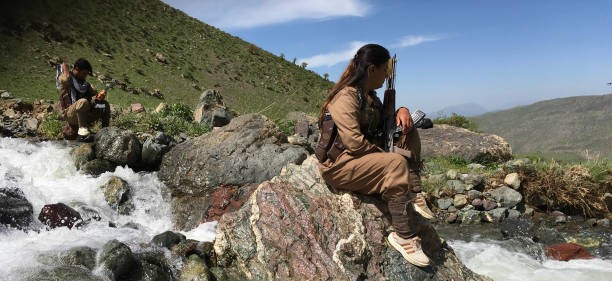
This interview was conducted in a calm and tension-free atmosphere in one of the old neighborhoods of Mahabad. The conversation between her and the reporter of the Iranian Kurdistan Human Rights Watch (IKHRW) took the form of an informal, narrative dialogue, aiming to record her lived experience without direct intervention. A video version of this interview is also available.
Although Parisa Feyzi stated that she has no issue with her identity being known, she prefers her face not to be clearly displayed, considering the release of the audio or written transcript more appropriate. According to her, this choice is primarily to protect her privacy and distance herself from her past.
During the interview, her father was also present at home. He reacted to parts of his daughter’s narrative with silence and short gestures—such as shaking his head or expressing regret. His presence transformed the conversation from a purely individual account into a shared family experience.
Feyzi states that she possesses no photographs or documents from her time with the party. According to her, prior to her departure, the information on her mobile phone was inspected and deleted by officials of the group; an action she described as part of their systematic control over personal communication and individual data.
Q&A Section
-
Question: Could you introduce yourself and tell us how you entered this path?
-
Answer: I am Parisa Feyzi, from Mahabad, and I am now 18 years old. When I entered the party, I was only 16 years old. I became acquainted with the Democratic Party of Iranian Kurdistan (PDKI) through Instagram. After a while, they sent someone to pick me and another girl up. We left Iran illegally through the Piranshahr route and entered their camps. At that age, I had neither an accurate understanding of the conditions nor a comprehension of the consequences; it was a decision shaped more by the environment and online interactions than an informed choice. This later made me realize that the recruitment of individuals under 18 into such environments places them directly in harm’s way and forces them into decisions beyond their intellectual maturity.
-
Question: What stages did you go through after your arrival?
-
Answer: We spent 20 days in the reception sector of one of the camps, then entered military training, and after that, we were organized and deployed to the mountains. From the very beginning, the path was designed to rapidly assimilate the individual into the structure, making any return or serious reconsideration extremely difficult.
-
Question: Did you get married there?
-
Answer: Yes. In the mountains, I met an individual named Pejman. He worked in the finance section and was also from Mahabad. Sometime later, he proposed, and we married. In an environment that closed off all access to family or external support, such decisions were driven more by a desperate need for security than a free and sustainable choice.
-
Question: When did you discover his background?
-
Answer: After our marriage, I found out that he had committed fraud in Iran and had fled due to an active arrest warrant. There were many individuals like him who had joined the party solely to escape criminal prosecution. This revealed to me that the group lacks any transparent vetting process for checking individuals’ backgrounds, which severely threatens personal safety, especially for women.
-
Question: How was your life after marriage?
-
Answer: There was absolutely no institutional support. If someone married, their own family had to support them financially. After my mandatory service period ended (two years for me and five years for him), we left the party. In reality, the individual is strictly controlled during their presence but left completely abandoned upon departure.
-
Question: What happened after you left?
-
Answer: We went to Sulaymaniyah and wandered aimlessly for a month. He claimed he could not work and could not afford our living expenses. I was forced to contact my father, who came and brought me back to Iran. Afterward, I obtained a default divorce in Iran. I was divorced at the age of 17. This experience epitomized the true meaning of the “lack of post-exit support”; a place where an individual is secure neither inside the structure nor outside it.
-
Question: Why did you not return sooner?
-
Answer: They kept telling us that if we returned to Iran, we would face at least five years in prison. They also claimed we would be subjected to rape and interrogated daily. These manufactured fears prevented me from returning before my marriage. However, when I returned, I realized none of it was true. This propaganda stripped us of our decision-making capacity; a fear that kept us trapped and created permanent psychological duress.
-
Question: What was the status of women’s safety?
-
Answer: Women had no safety. There was a case where a Peshmerga raped a girl named Arina, who was from Baneh. The perpetrator was Shahram Habibi, from Piranshahr. They expelled him from the party, but no serious legal action was taken against him; he eventually returned and became a Peshmerga again. When such atrocities occur without serious accountability, the message is clear: women’s safety is not a priority.
-
Question: Were there other cases?
-
Answer: Yes. Several other men gang-raped another girl. I even heard of a case involving the sexual assault of a boy. These incidents, alongside the lack of effective judicial review, proved that sexual violence is prevalent and that no mechanism exists to protect or support the victims.
-
Question: What was your experience regarding cross-border operations?
-
Answer: They conducted armed operations regularly. They systematically deployed new recruits—even young girls—inside Iran, completely indifferent to what might happen to them. Human lives were put at risk very easily. To me, this meant inexperienced forces were utilized purely as expendable assets in high-risk zones.
-
Question: What was the role of the commanders?
-
Answer: The commanders themselves resided comfortably in cities or in Europe, and their families lived entirely outside the conflict zones. Meanwhile, we were left to survive in the mountains. When we protested, they would dismissively say, “You came here on your own accord.” The disconnect between the decision-makers and those exposed to danger was total.
-
Question: What were the daily living conditions like?
-
Answer: We had grueling guard duties, sometimes lasting until six in the morning. When the camps were bombarded, we had to stay in the mountains for up to a week without any basic amenities. We slept in sleeping bags and sometimes went weeks without bathing. These conditions are unimaginable for a normal life; the bare minimum of human dignity was entirely ignored.
-
Question: What restrictions were imposed upon your departure?
-
Answer: When I left, they mandated that I delete my Instagram account, forcing me to comply. Even after exiting, a form of control over personal communication was maintained, as if independent agency was never fully restored to the individual.
-
Question: What was the ultimate takeaway of this experience for you?
-
Answer: I ended up divorced at the age of 17. What they showcased in their media propaganda was entirely divorced from reality. The “freedom” and “security” they preached did not exist. New recruits were sent to perilous operations, women possessed no safety, and complaints were systematically ignored. For me, this experience was a web of contradictions where fundamental human rights—from bodily safety to the freedom of choice—were severely restricted.