
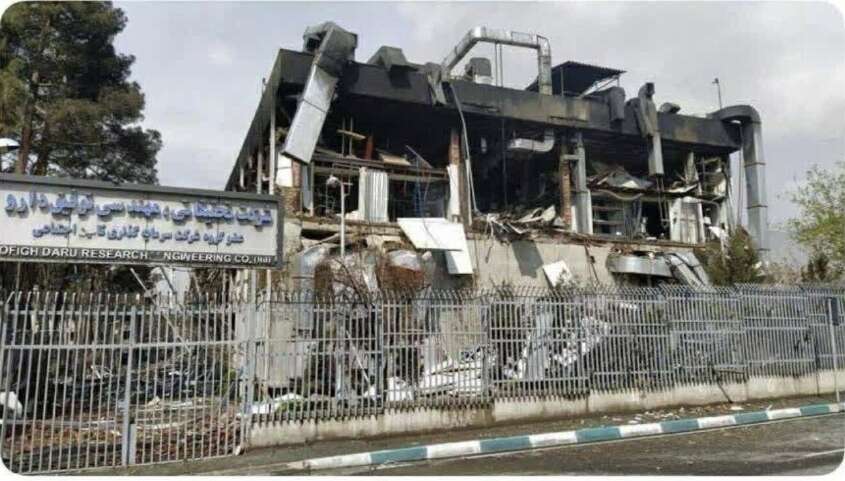
According to an official report released on March 31 2026 by the Director General of Crisis Management for West Azerbaijan Province, an under-construction research center located on the Salmas–Tasuj road was targeted by a missile attack attributed to the United States and Israel. According to statements by Hamed Saffari, this facility had not yet reached the operational stage. The attack caused severe damage to the main building and its towers, with at least one individual reported injured.
The civilian and investigative nature of this center, combined with its non-operational status, are key factors in the legal assessment of this incident.
Violations of International Law
1. Violation of the Prohibition of the Use of Force
Under Article 2, Paragraph 4 of the UN Charter, all states are prohibited from the threat or use of force against the territorial integrity or political independence of any other state. A missile attack on facilities located within the territory of a state without a UN Security Council mandate or the fulfillment of self-defense conditions (Article 51) constitutes a fundamental breach of this principle.
2. Violation of the Principle of Territorial Sovereignty
The principle of territorial sovereignty is a cornerstone of customary international law. Any military action within the territory of a state without its explicit consent is a direct violation of its independence and sovereignty.
3. Violation of International Humanitarian Law (IHL)
Given the civilian nature of this research facility, the attack violates the fundamental principles of the law of armed conflict:
-
The Principle of Distinction: The requirement to distinguish between military objectives and civilian objects (Article 48 of the 1977 Additional Protocol I to the Geneva Conventions).
-
Prohibition of Attacks on Civilian Objects: Under Article 52 of Additional Protocol I, civilian objects are immune from attack.
-
The Principle of Proportionality: Prohibiting attacks where the incidental civilian damage is excessive in relation to the anticipated military advantage (Article 51, Paragraph 5 of Additional Protocol I).
4. Threat to International Peace and Security
Such actions may be reviewed by the UN Security Council under Article 39 of the UN Charter as a “threat to peace and security.”
Legal References
-
UN Charter: Article 2(4) (Prohibition of the Use of Force), Articles 39 and 51.
-
Geneva Conventions (1949) and Additional Protocol I (1977): Articles 48, 51, and 52.
-
Customary IHL: Regarding the principle of distinction and protection of civilian targets.