
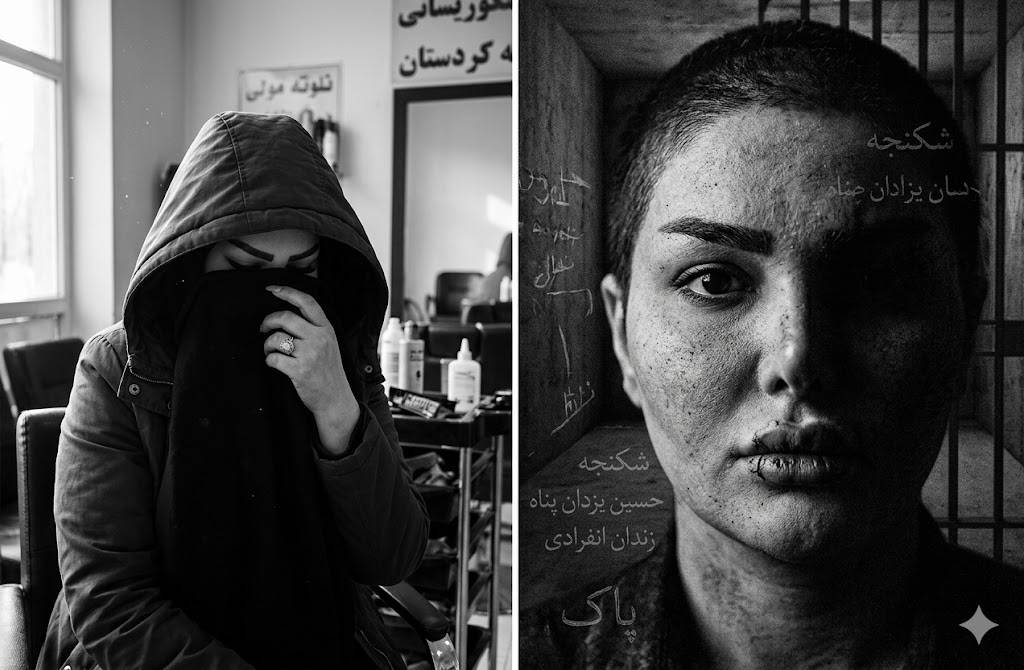
In a city in Kurdistan, within a small tailor shop on the outskirts of town, a woman sat before us, the signs of anxiety and fear still visibly etched into her face and demeanor. Using the pseudonym “Zhina,” she agreed to speak about her five-year ordeal inside the headquarters of the armed group known as PAK (Kurdistan Freedom Party)—years that, according to her, were defined by imprisonment, torture, deprivation, threats, psychological duress, and the complete collapse of her family. She states that she still harbors an intense dread of Hussein Yazdanpanah, which is why she requested her voice remain unrecorded and her full name concealed. The face-to-face interview took place at her workplace, where she repeatedly emphasized that the nightmares of that era still haunt her.
Zhina begins her account by saying: “Today, if I see any youth or teenager showing even the slightest interest in these Kurdish armed parties and groups, I stop them and talk to them for hours. I feel it is my duty to explain the reality of that place. I tell them, ‘If you want to step into hell, join these groups—especially PAK.’ I was there for five years, and perhaps few people have touched those conditions as closely as I did, and few have been tortured time and again by Hussein Yazdanpanah himself. Of course, he personally tortured everyone, as if he derived pleasure from it, but he tortured me more than anyone else.”
She explains that unlike many members in the camps, she did not join due to financial distress or homelessness: “I had a good life in my city; I owned a house, a car, and had a stable job and income. I was a tailor, completely detached from politics and knowing absolutely nothing about it. I only went there to bring back my nephew. My nephew suffered from addiction, and two individuals deceived him under the pretext of securing a job and addiction treatment, taking him to Iraq. There, he became trapped by the PAK group and remained. I went to get him back. In addition to my nephew, my sister also became trapped in this group. She stayed there, married, and had a child, but later her husband was imprisoned under various fabricated charges without any transparent legal process. My sister’s husband, identified by the pseudonym ‘A.M.,’ was jailed for seven months in a concrete room, bound by handcuffs and shackles, under intense pressure. When he was released, he was so physically emaciated that his acquaintances could barely recognize him; he was nothing but skin and bones. ‘A.M.’ was one of the commanders who had participated in military training courses conducted by U.S. officers. They told me that if I stayed in the headquarters for three months, they would release my nephew to return to Iran.”
According to her, the living conditions from the very first days were shocking: “I was under immense psychological pressure. I protested, an altercation ensued, and I even drew a weapon, stating I could not stay here. At that exact moment, they seized me, imprisoned me, and began torturing me.”
She notes that after protesting the status quo, she was accused of espionage: “They kept telling me, ‘You have been sent by Iran to destroy the headquarters.’ No matter how much I explained that I had only come for my nephew, it was useless. I was imprisoned for 22 days in a concrete cell; my hands were chained to a metal bar, and I was fitted with handcuffs and shackles. I slept directly on the bare concrete floor.”
Zhina speaks of the severe psychological scars from that period: “After some time, I fell into a deep depression. I shaved off my hair with a razor, and scraped off my eyebrows and eyelashes. I had completely collapsed psychologically. Later I learned that when I mentioned wanting to shave my hair, Hussein Yazdanpanah had ordered, ‘Give her a razor so she can do it.’ That was when I realized that a human being’s destruction meant nothing to them.”
She adds that even after leaving the cell, she was practically kept under house arrest: “They transferred me to another room. They provided food only once every three days. I was forbidden from doing anything. The mental duress intensified, and my psychological state deteriorated into a total breakdown.”
She then points to an incident she considers one of the bitterest experiences of her life: “When I insisted on returning to Iran, they told me I would only be allowed to leave if I complied with their sexual demands. They knew that if I returned to Iran, I would expose the events inside the camp, which is why I was subjected to severe extortion and pressure.”
According to her, the surveillance and pressure continued even after her return to Iran: “Hussein Yazdanpanah called me several times, demanding that I conduct missions for them inside Iran. He even offered me a house and an SUV. I refused.”
Zhina dedicates a significant part of her testimony to the status of human rights within the camps. She notes that free communication with families was virtually non-existent, and when serious violations occurred, they went uninvestigated, sending a clear message that women’s safety was never a priority.
Q&A Section
-
Question: Were there other instances of abuse?
-
Answer: Yes. Several individuals gang-raped another girl. I even heard of a case where a boy was subjected to sexual assault. These incidents, combined with the total lack of effective accountability, proved that sexual violence is not only prevalent but that there is absolutely no mechanism to support the victims.
-
Question: What was your experience regarding cross-border operations?
-
Answer: They conducted operations regularly. They would systematically deploy new recruits—even young girls—inside Iran, completely indifferent to their fate. Human lives were put at risk with ease. To me, this meant that inexperienced recruits were utilized purely as expendable assets in high-risk situations.
-
Question: What was the role of the senior commanders?
-
Answer: The commanders themselves resided comfortably in cities or in Europe, and their families lived entirely outside the conflict zones. Meanwhile, we were left to rot in the mountains. When we protested, they would dismissively say, ‘You came here on your own accord.’ The disparity between the decision-makers and those exposed to imminent danger was stark.
-
Question: What were the daily living conditions like?
-
Answer: We had grueling, exhausting guard duties, sometimes lasting until six in the morning. When the headquarters were hit by bombardments, we would be stranded in the mountains for up to a week without any basic amenities. We slept in sleeping bags on open ground and sometimes went weeks without bathing. These conditions are unimaginable for a normal life; the bare minimum of human dignity was ignored.
-
Question: What restrictions were imposed upon your departure?
-
Answer: When I finally left, they mandated that I delete my Instagram account, forcing me to comply. Even after exiting, a strict control over personal communication was maintained, as if independent agency was never fully restored to the individual.
-
Question: What was the ultimate takeaway of this experience for you?
-
Answer: I was divorced at the age of 17. What they showcased in their media propaganda was entirely divorced from reality. The ‘freedom’ and ‘security’ they preached did not exist. New recruits were sent to perilous operations, women possessed no safety, and if we filed a complaint, it was systematically ignored. For me, this experience was a web of contradictions; a place where promises fell short of reality, and in practice, fundamental human rights—from bodily safety to the freedom of choice—were severely violated.